Culture
The State Hermitage Museum: Catherine the Great's 1764 Collection and Russia's Greatest Art Treasury
The State Hermitage Museum in St. Petersburg — founded in 1764 when Catherine the Great acquired 225 paintings from a Berlin merchant — is the second-largest art museum in the world. Housed in the magnificent Winter Palace, its three million objects span from Paleolithic artefacts to Picasso.
The State Hermitage Museum (hermitagemuseum.org) in St. Petersburg, Russia, is one of the largest and most magnificent art museums in the world. Founded in 1764 when Empress Catherine the Great acquired a collection of 225 paintings from the Berlin merchant Johann Ernst Gotzkowsky — originally intended for Frederick the Great of Prussia, who had refused the consignment — the museum has grown over two and a half centuries into an institution of extraordinary scope and grandeur. The Hermitage's collections now encompass over three million items, of which only a fraction are on display across the museum's six historic buildings.
The name 'Hermitage' (from the French ermitage, meaning a retreat or hermitage) derives from the Small Hermitage, the pavilion Catherine built beside the Winter Palace in 1764–75 as a private gallery for her growing art collection, where she hosted intimate gatherings away from the formal court. The collection was not opened to the public until 5 February 1852, when the New Hermitage — the first building in Russia purpose-built as a public art museum — was inaugurated under Emperor Nicholas I.
The Winter Palace
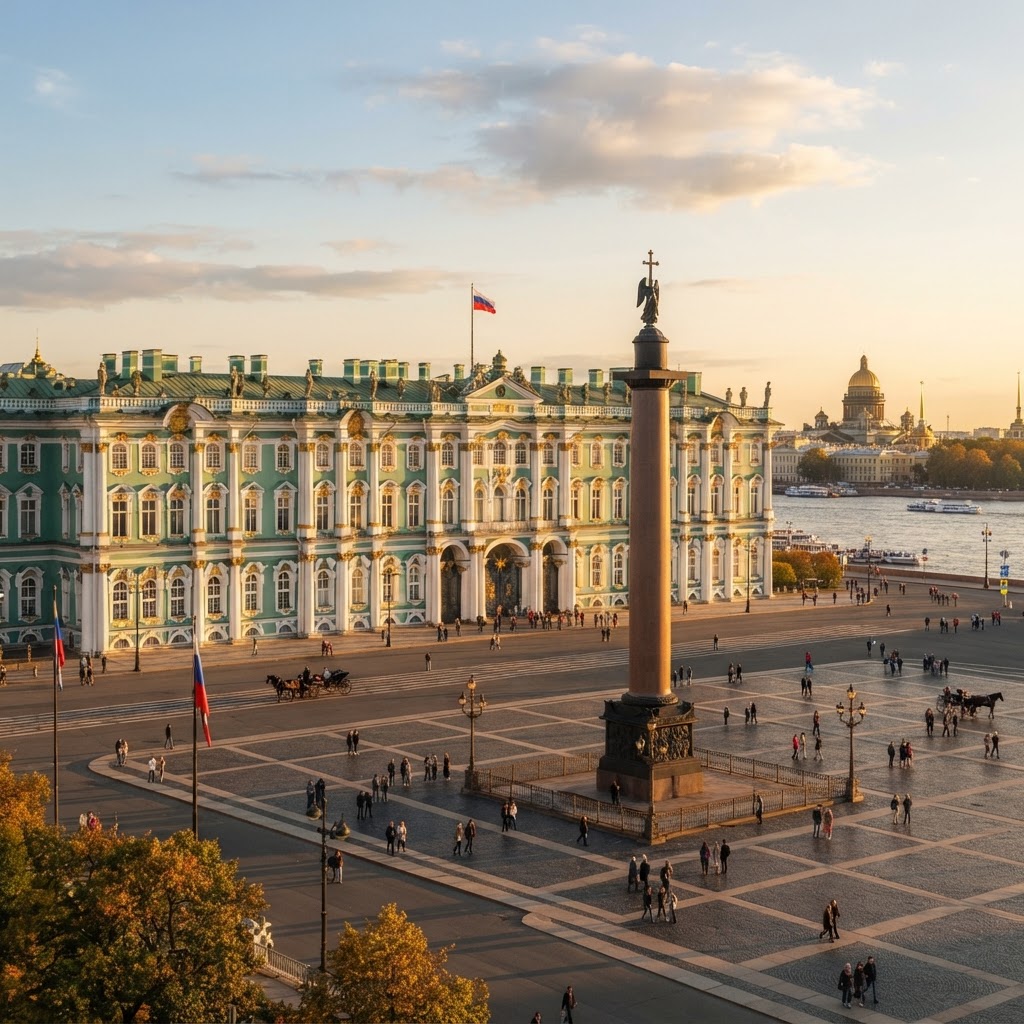
The heart of the Hermitage complex is the Winter Palace (Zimniy Dvorets), the principal residence of the Russian tsars from 1732 to 1917. The palace visible today — the fourth on the site — was designed by the Italian architect Bartolomeo Rastrelli in the elaborate Elizabethan Baroque style and was built between 1754 and 1762, during the reign of Empress Elizabeth. Its green-and-white stucco façade extends for 215 metres along the Neva River, with 1,500 rooms, 1,945 windows, and 117 staircases. The palace was the setting for the 1905 'Bloody Sunday' massacre and the storming of the palace during the October Revolution of 1917 — though, contrary to popular mythology, the palace was largely undefended and the 'storming' was a relatively bloodless affair.
The Collections
The Hermitage's holdings are vast and encyclopaedic, spanning from prehistoric cultures to the 20th century. The most celebrated departments include:
**Western European Art** — the core of Catherine's original collection, expanded by subsequent tsars and by nationalisation of private collections after the Revolution. The museum holds one of the finest collections of Italian Renaissance art in the world, including two paintings by Leonardo da Vinci (the 'Madonna Litta' and the 'Madonna Benois'), works by Raphael, Giorgione, Titian, and Caravaggio. The Dutch and Flemish collection includes 24 paintings by Rembrandt (the largest Rembrandt collection outside the Netherlands), as well as works by Rubens, Van Dyck, and Frans Hals. The Impressionist and Post-Impressionist collection — much of it acquired from the private collections of Moscow merchants Sergei Shchukin and Ivan Morozov, nationalised after the Revolution — includes major works by Matisse, Picasso, Monet, Renoir, Cézanne, and Gauguin.
**The Scythian Gold** — one of the most extraordinary archaeological collections in the world, including the gold and jewellery of the nomadic Scythian peoples who dominated the Eurasian steppe from the 7th to the 3rd centuries BC. The most celebrated piece is the gold comb (c. 5th century BC) depicting a battle scene.
**The Treasure Gallery (Diamond Chamber)** — a collection of imperial jewels, including the personal jewellery of Catherine the Great and other Romanov tsars. Visitable only by special pre-booked tour.
The Rooms and Halls
The state rooms of the Winter Palace are themselves masterpieces of 18th- and 19th-century interior design. The Jordan Staircase — Rastrelli's ceremonial staircase of white marble and gilded stucco, the grandest in any European palace — is the first sight that greets visitors. The Pavilion Hall, with its gilded arcades and the famous Peacock Clock — an 18th-century automaton of gilded bronze featuring a peacock, an owl, and a cockerel — is among the museum's most photographed rooms. The St George Hall (the Great Throne Hall), rebuilt after a fire in 1837, was the ceremonial throne room of the Russian Empire.
Practical Information
The Hermitage is open Tuesday–Sunday (closed Mondays). The main complex is on Palace Square (Dvortsovaya Ploshchad) on the Neva River in central St. Petersburg. The museum is vast — a full visit requires a minimum of a full day, and most visitors return multiple times. Online ticket purchase is recommended. Reference: [The State Hermitage Museum Official](https://www.hermitagemuseum.org)
Reference Links:
- The State Hermitage Museum: hermitagemuseum.org
- The Hermitage Amsterdam (satellite): hermitage.nl
- Visit St. Petersburg: visit-petersburg.ru
- Rastrelli and the Winter Palace: hermitagemuseum.org
- The Peacock Clock: hermitagemuseum.org
- Russian Museum (St. Petersburg): rusmuseum.ru
Continue Reading