Wellness
Sound Healing and the Wellness Frontier
From Tibetan singing bowls to binaural beats, sound-based therapies are moving from the fringe to the clinical mainstream. A clear-eyed guide to what the evidence actually says.
Sound has been used as a healing modality across virtually every human culture — from the overtone chanting of Tibetan Buddhist monks to the didgeridoo ceremonies of Aboriginal Australians, the Sufi sama, and the ancient Greek practice of treating illness in acoustically designed healing temples. What is new is the application of rigorous scientific methodology to understanding why these practices work.
The most robust body of evidence concerns **binaural beats** — an auditory processing artefact that occurs when two slightly different frequencies are presented separately to each ear. The brain 'hears' the mathematical difference between the two frequencies as a third tone, and research published in journals including Frontiers in Human Neuroscience (frontiersin.org) consistently demonstrates that specific frequency differentials entrain brainwave activity: 4–8Hz (theta range) promotes deep relaxation and creativity; 8–12Hz (alpha) promotes calm alertness; 14–30Hz (beta) supports focus and problem-solving. Apps like Brain.fm (brain.fm) use neuroscience-graded binaural audio for focus and sleep.
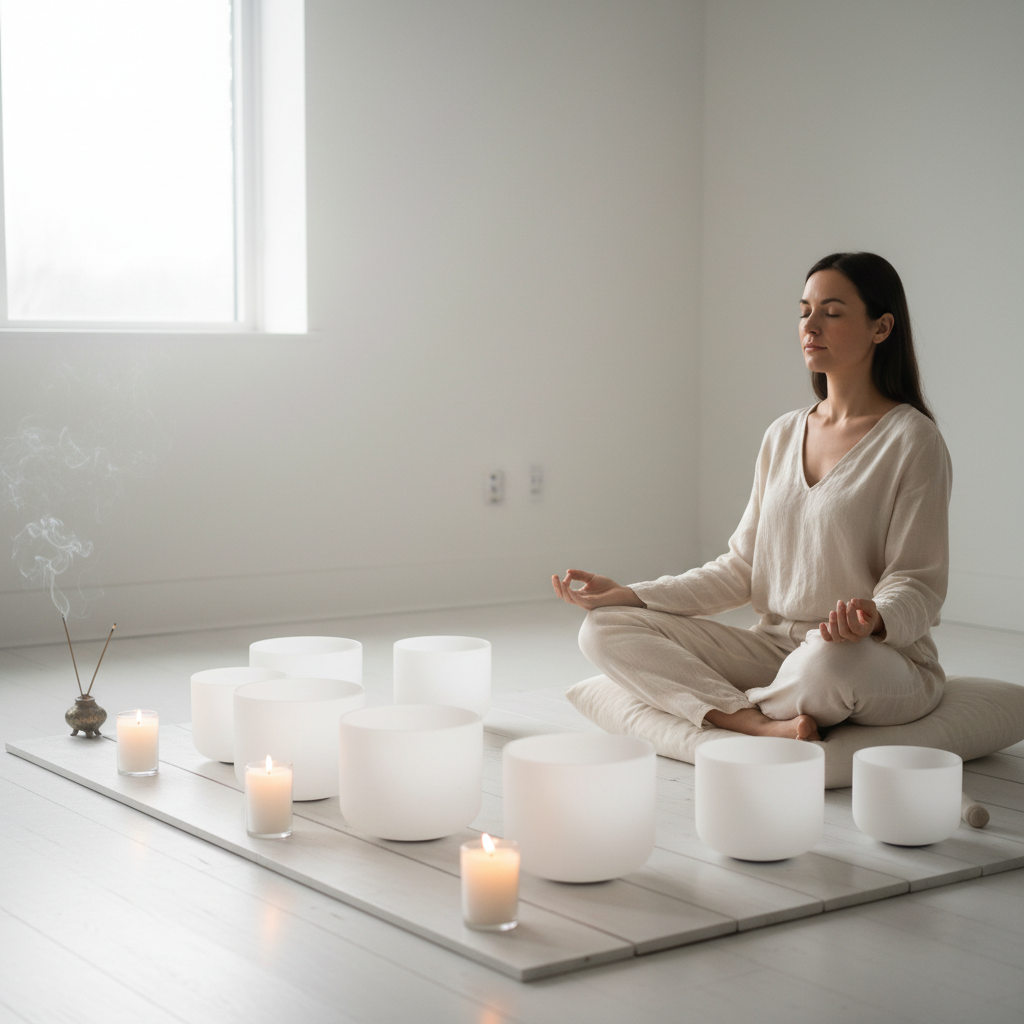
**Singing bowls and sound baths**: Crystal and Tibetan metal singing bowls produce rich harmonic overtones that create measurable changes in brainwave activity. A peer-reviewed 2016 study published in the Journal of Evidence-Based Complementary & Alternative Medicine found that a 60-minute sound bath significantly reduced tension, anxiety, and physical pain while increasing spiritual wellbeing. The study's 62 participants showed significant improvement across all measured outcomes. Peter Hess Sound Massage (peter-hess-akademie.de), based in Germany, is among the most rigorously trained practitioner networks globally.
**ASMR**: Autonomous Sensory Meridian Response — the tingling, deeply relaxing sensation triggered in susceptible individuals by soft sounds, whispering, and gentle tapping — is now estimated to affect approximately 20% of the population and has been the subject of neuroscience research at the University of Sheffield (sheffield.ac.uk) confirming its stress-reduction and pain-relief properties.
**Accessible practice**: The most practical entry point is a high-quality sound bath recording — the Insight Timer app (insighttimer.com) has thousands of free guided sound meditations, ranging from 10-minute binaural sessions to full 90-minute sound bath recordings. For in-person practice, most major cities now have sound bath studios; in London, Re:Mind Studio (remindsudio.com) and the Indaba Yoga Studio (indabayoga.com) offer regular sessions.


Continue Reading