Culture
The Sistine Chapel: Michelangelo's Ceiling and the Greatest Art in the Vatican
The Sistine Chapel in Vatican City — the papal chapel built between 1473 and 1481 — contains two of the greatest works of art ever created: Michelangelo's ceiling frescoes (1508–1512) and his Last Judgment (1536–1541). This is the definitive guide to the most famous ceiling in the world.
The Sistine Chapel (Cappella Sistina) is the principal papal chapel of the Apostolic Palace in Vatican City, the residence of the Pope in Rome. It was built between 1473 and 1481 by the architect Giovanni dei Dolci, under Pope Sixtus IV (della Rovere), from whom the chapel takes its name, and it has served as the venue for the most important papal ceremonies — including the conclave, the meeting of the College of Cardinals that elects a new Pope — since the 15th century.
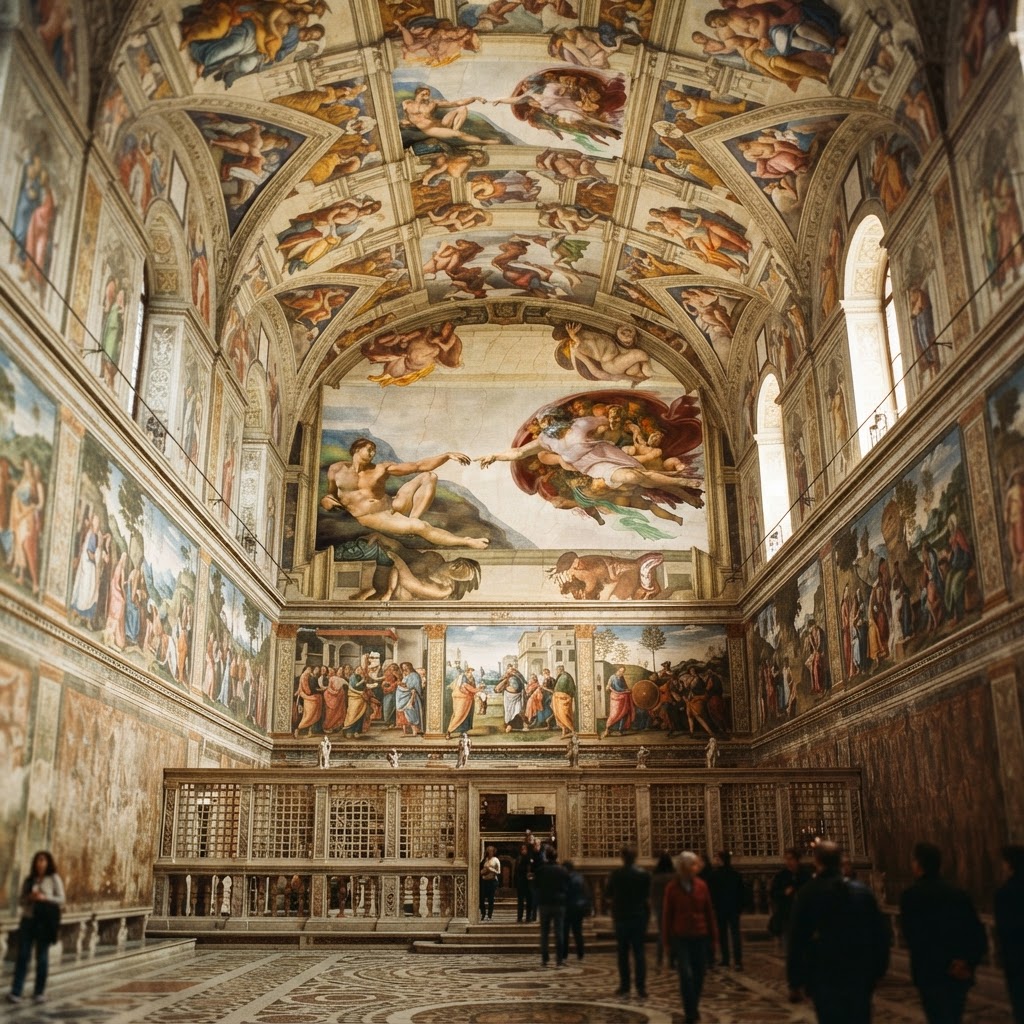
The chapel is a rectangular hall, 40.9 metres long, 13.4 metres wide, and 20.7 metres high — dimensions that are said to correspond to those of the Temple of Solomon as described in the Old Testament. Its walls were decorated in the early 1480s by a team of the leading painters of the early Italian Renaissance — including Sandro Botticelli, Pietro Perugino, Domenico Ghirlandaio, and Cosimo Rosselli — with a cycle of frescoes depicting the lives of Moses and of Christ, representing the Old and New Testaments. These frescoes are among the finest works of the early Renaissance and are themselves masterpieces.
The Ceiling
In May 1508, Pope Julius II (della Rovere) commissioned Michelangelo Buonarroti to paint the ceiling of the Sistine Chapel. Michelangelo, who was 33 years old and who considered himself a sculptor rather than a painter, was reluctant to accept the commission, and the relationship between the famously tempestuous Michelangelo and the famously forceful Julius was one of the most fraught and consequential in the history of art. Michelangelo worked on the ceiling for four years, from 1508 to October 1512, painting in the difficult medium of fresco (pigment applied to wet plaster) while lying on his back on a scaffolding of his own design.
The ceiling depicts the story of the creation and the early history of humanity, as told in the Book of Genesis, across nine central panels:
**The Creation of Adam** — the most famous of all, in which God, borne aloft by angels and wrapped in a cloak that has been interpreted as a cross-section of the human brain, extends his finger toward the reclining Adam, whose own finger reaches out to meet God's. The fraction of space between the two fingers — the spark of life about to be transmitted — is one of the most celebrated and reproduced images in the history of art.
**The Creation of the Sun, Moon, and Planets**, **The Separation of Land and Water**, **The Creation of Eve**, **The Fall of Man and the Expulsion from the Garden of Eden**, **The Sacrifice of Noah**, **The Great Flood**, and **The Drunkenness of Noah** — the nine panels are framed by painted architectural elements and surrounded by figures of prophets and sibyls, nude male figures called ignudi, and the ancestors of Christ.
The Last Judgment
Twenty-four years after completing the ceiling, Michelangelo returned to the Sistine Chapel to paint the Last Judgment, the vast fresco on the altar wall, commissioned by Pope Clement VII and completed under Pope Paul III between 1536 and 1541. The fresco, which replaced the earlier wall paintings of the 1480s, depicts the Second Coming of Christ and the Last Judgment of the souls of humanity, with the saved ascending to heaven and the damned dragged down to hell. The muscular, contorted figures, and the depiction of a beardless Christ as a figure of terrifying power, reflect the spiritual crisis of the Reformation and the Sack of Rome (1527). It is one of the most powerful works of art ever created.
Practical Information
The Sistine Chapel is the final room of the Vatican Museums (Musei Vaticani, museivaticani.va) complex, which also includes the Raphael Rooms, the Gallery of Maps, and the Borgia Apartment. The museums are located on Viale Vaticano in Rome, and are open Monday to Saturday and the last Sunday of each month (free admission on the last Sunday). Advance online booking is strongly recommended to avoid queues that can last several hours. Photography is permitted in the Vatican Museums but is strictly forbidden in the Sistine Chapel itself. Reference: [Vatican Museums Official](https://www.museivaticani.va)
Reference Links:
- Vatican Museums: museivaticani.va
- The Sistine Chapel: museivaticani.va/content/museivaticani/en/collezioni/musei/cappella-sistina.html
- Vatican City State: vaticanstate.va
- Rome Tourism: turismoroma.it
- St. Peter's Basilica: saintpetersbasilica.org
- Italian Tourism: italia.it
Continue Reading