Travel
Seoul, South Korea: Palaces, K-Culture, and Korean Luxury
Seoul is one of the most dynamic cities in Asia — a metropolis where 600-year-old palaces stand beside skyscrapers, and where the global phenomenon of K-culture was born.
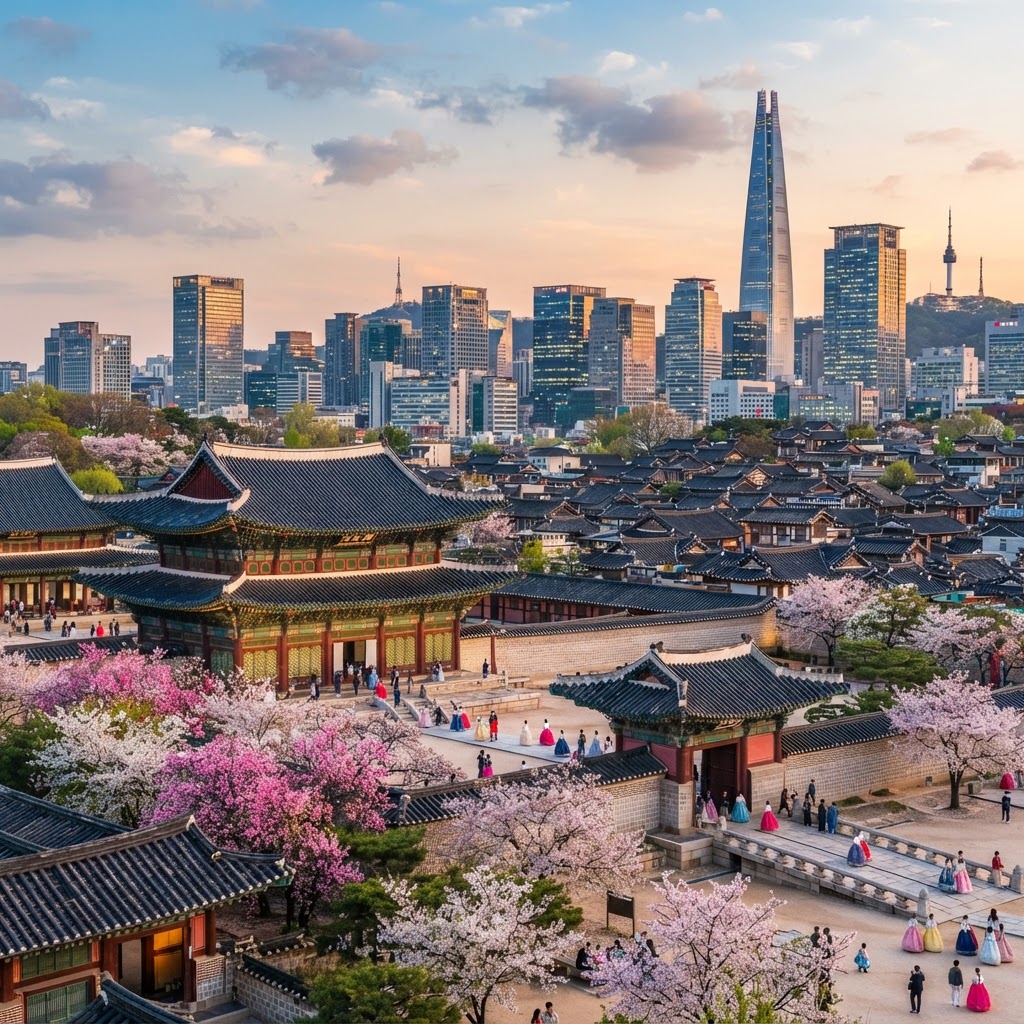
Seoul, South Korea is one of the most dynamic and fascinating cities in Asia. A sprawling metropolis of nearly 10 million people, it is a city where the sixth century and the twenty-first century coexist in remarkable harmony: the 600-year-old Joseon dynasty palaces sit within walking distance of the world's most advanced technology districts, and the ancient traditions of Korean tea ceremony and Buddhist temple life continue alongside the global phenomenon of K-pop, K-drama, and K-beauty.
The Joseon Palaces
Seoul was established as the capital of the Joseon dynasty in 1394 by King Taejo, and for over 500 years it served as the seat of Korean royal power. Five grand palaces from this period survive, and together they form one of the most extraordinary ensembles of traditional East Asian architecture in the world.
**Gyeongbokgung Palace** (the Palace of Shining Happiness) is the grandest of the five. First built in 1395, it was destroyed during the Japanese invasions of 1592 and lay in ruins for 250 years until it was rebuilt in 1867. The palace was again largely destroyed during the Japanese colonial period (1910-1945), but a decades-long restoration project has brought many of its buildings back to their original grandeur. The changing of the guard ceremony, performed daily in traditional Joseon uniforms, is one of Seoul's most popular spectacles.
**Changdeokgung Palace** (the Palace of Illustrious Virtue), built in 1405, is a UNESCO World Heritage Site, inscribed in 1997 for its exceptional harmonious integration with its natural landscape. The palace's **Secret Garden** (Huwon) — a 78-acre garden of pavilions, lotus ponds, and ancient trees — is one of the most beautiful private gardens in East Asia.
The Hanok Villages
**Bukchon Hanok Village**, located between Gyeongbokgung and Changdeokgung palaces, is a neighbourhood of over 900 traditional Korean houses (hanok) dating to the Joseon dynasty. The village was the residential quarter of the Joseon aristocracy and high-ranking government officials. Today, many of the hanoks have been converted into cultural centres, tea houses, and guesthouses, and walking the narrow streets between the tile-roofed houses, with the modern skyscrapers of Seoul's financial district visible in the distance, is one of the most extraordinary urban experiences in Asia.
Shopping and Culture
**Myeongdong** is Seoul's most famous shopping district, a dense warren of streets lined with Korean beauty brands, international fashion houses, and food stalls serving the full spectrum of Korean street food. It is the epicentre of K-beauty, with flagship stores for brands including Amorepacific, Sulwhasoo, and Innisfree.
**Gangnam** — the district south of the Han River that was made globally famous by PSY's 2012 hit 'Gangnam Style' — is Seoul's most modern and affluent neighbourhood. The COEX Mall, one of the largest underground shopping complexes in Asia, and the Starfield Library (a multi-storey public library within the mall) are among its most popular attractions.
The Hotels
**The Shilla Seoul** is South Korea's preeminent luxury hotel. Operated by the Shilla hotel group (a subsidiary of the Samsung conglomerate), it is the hotel of choice for visiting heads of state and is a member of The Leading Hotels of the World. The hotel's fine dining restaurant, Juk Gyung Dang, offers one of the finest Korean tasting menus in Seoul.
**Signiel Seoul**, located on the 76th to 101st floors of the Lotte World Tower — at 555 metres, the fifth-tallest building in the world — is the highest luxury hotel in Korea. The views from the upper floors, over the entire Seoul metropolitan area and the surrounding mountains, are among the most dramatic in any hotel in Asia.
**The Banyan Tree Club and Spa Seoul** is an urban resort perched on Mount Namsan, in the geographic centre of Seoul, with sweeping views of the city.
Dining: Michelin Stars and Korean Cuisine
Seoul's dining scene has been transformed in the past decade, and the Michelin Guide Seoul (first published in 2016) now lists over 30 starred restaurants. **Mingles**, under chef Kang Min-goo, holds three Michelin stars for its modern interpretation of Korean cuisine, incorporating traditional fermentation techniques and Korean sauces (jang) into a refined tasting menu.
**Jungsik**, chef Yim Jungsik's two-Michelin-starred restaurant in the Cheongdam district, is one of the pioneers of modern Korean fine dining and has been named one of Asia's 50 Best Restaurants.
For traditional Korean barbecue, **Mapo Kalbit** and **Byeokje Galbi** are among the most celebrated in Seoul. For Korean temple food (the vegetarian cuisine developed by Buddhist monks), **Balwoo Gongyang**, run by the Jogye Order of Korean Buddhism, holds a Michelin star.
Reference Links:
- Korea Tourism Organization: visitkorea.or.kr
- The Shilla Seoul: shillahotels.com
- Signiel Seoul: signiel.com
- UNESCO Changdeokgung Palace: whc.unesco.org/en/list/876
- Michelin Guide Seoul: guide.michelin.com/en/seoul
- Gyeongbokgung Palace: royalpalace.go.kr
- Bukchon Hanok Village: bukchon.seoul.go.kr
Continue Reading