Culture
Rio Carnival: The Greatest Show on Earth and How to Experience It
The Sambadrome. The samba schools. The costumes, the drums, the scale. Rio de Janeiro's Carnival is the most spectacular cultural event in the world — and this is how to experience it properly.
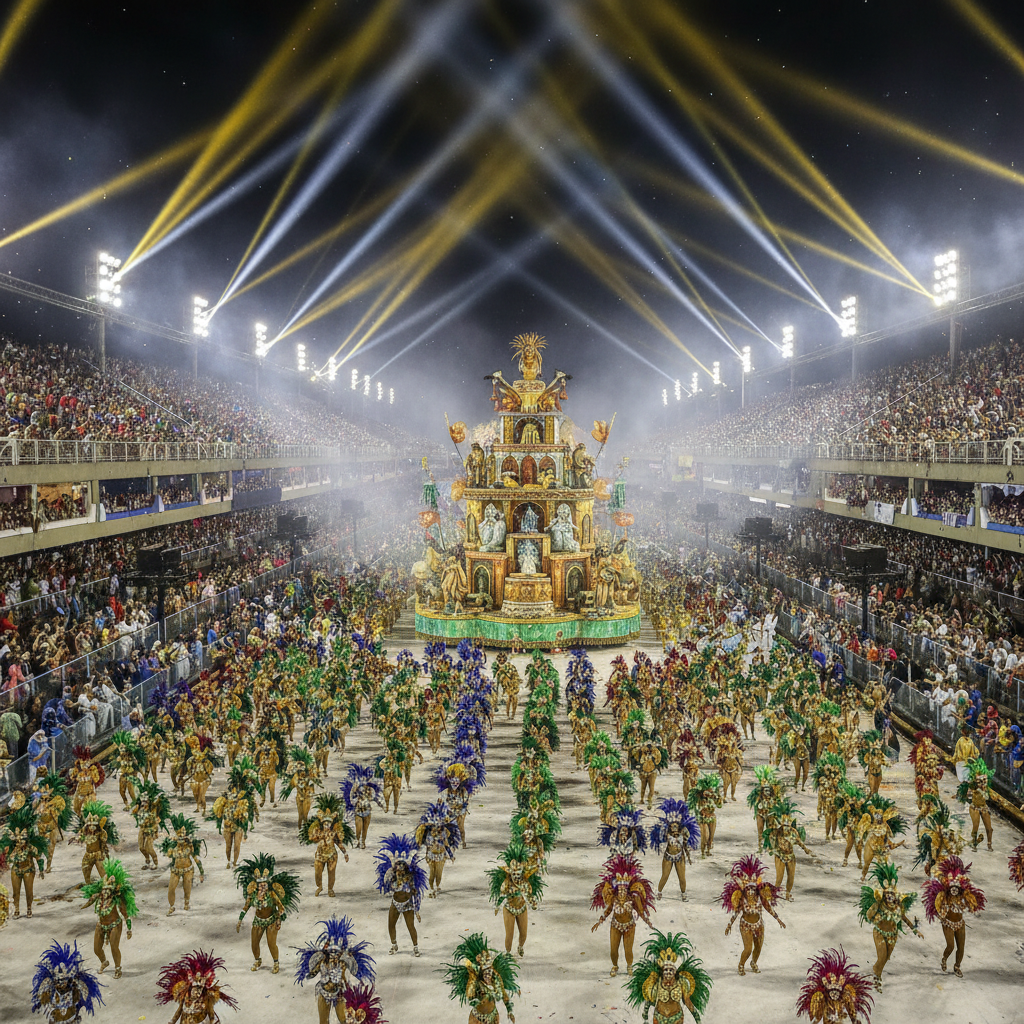
There is no cultural event on earth with the physical spectacle of Rio de Janeiro's Carnival. The Edinburgh Festival Fringe is more intellectually dense; Glastonbury is more musically varied; the Venice Biennale is more critically significant. But for sheer sensory impact — the scale, the noise, the colour, the human energy concentrated into a single competitive parade — nothing compares to the Special Group parades at the Sambódromo Marquês de Sapucaí during the five days before Ash Wednesday each year.
**The History**
Carnival's roots in Rio trace back to the Portuguese entrudo — a raucous street celebration brought by Portuguese colonisers in the 17th century. African cultural traditions, brought by enslaved people transported to Brazil, fused with this European festivity and by the 19th century had produced the distinctively Afro-Brazilian character of Rio Carnival: the samba rhythm, the improvised street processions, the vibrant costuming.
The samba schools — escolas de samba — emerged in the poor hillside favelas of Rio in the 1920s. The first official competition between schools was held in 1932 in the Praça Onze neighbourhood. The Sambódromo, designed by Oscar Niemeyer and inaugurated in 1984, gave the parade a permanent purpose-built home: a 700-metre runway flanked by permanent grandstands accommodating 90,000 spectators, in the Cidade Nova district of central Rio. Reference: riocarnaval.org
**The Samba Schools**
Rio's Special Group — the premier competitive tier — currently comprises twelve schools, each representing a different neighbourhood or region of the city. The most storied schools include Mangueira (founded 1928, associated with the favela of the same name, Brazil's most celebrated school), Portela (founded 1923, the most-decorated school in history with 22 championship titles), Beija-Flor de Nilópolis (consistent champion of recent decades), and Salgueiro (known for the most adventurous theme selection and spectacular costume design).
Each school parades for approximately 70–80 minutes, presenting 3,000–5,000 participants across fourteen wings (*alas*), each wing costumed in a distinct interpretation of that year's chosen theme (*enredo*). The parade is evaluated by a panel of forty judges on nine criteria including costumes, percussion (*bateria*), flag-bearer, float design, and overall harmony. The 2026 parades took place over two nights — February 14–15 and February 16–17 — with the Champion's Parade (Desfile das Campeãs) on the following Saturday.
**Getting Tickets**
Sambódromo tickets are sold through Liga Independente das Escolas de Samba do Rio de Janeiro (liesa.globo.com). The most accessible viewing is from the Sectors 5 and 9 grandstands; Sector 4, the 'camarotes' (luxury boxes), offers the best sightlines and is used by celebrities and corporate sponsors. Tickets range from approximately R$150 (general grandstand) to R$4,000+ (premium camarote). All tickets should be purchased well in advance — genuine tickets only through official LIESA channels or authorised resellers.
**Beyond the Sambódromo**
The blocos — free street parties spread across Rio's neighbourhoods — are the other dimension of Carnival experience. The Cordão da Bola Preta, Monobloco, and Sargento Pimenta are among the largest, drawing hundreds of thousands of participants through Copacabana, Ipanema, and the historic centre. They are chaotic, joyful, and entirely free.
Stay in the Ipanema or Leblon neighbourhoods for the best combination of safety, atmosphere, and proximity to both beach and city. The Hotel Fasano Rio (fasano.com.br/fasano-rio) — designed by Philippe Starck — is the most stylish address in the city; the Belmond Copacabana Palace (belmond.com/copacabana-palace) is the most historically resonant. Both host celebrated Carnival parties.
**A Note on Safety**
Rio requires the same urban awareness as any large city. Keep valuables to a minimum at street events, use registered taxis or the Uber app for transport, and stay aware of your surroundings in less frequented areas after dark. The Sambódromo itself is well-policed and generally safe throughout the parade nights.



Continue Reading


