Culture
Oktoberfest: The 1810 Wedding Celebration That Became the World's Greatest Folk Festival
Oktoberfest — the world's largest folk festival — began on 12 October 1810 as a celebration of the wedding of Crown Prince Ludwig of Bavaria and Princess Therese of Saxony-Hildburghausen. Two centuries later, over six million people gather annually on the Theresienwiese for sixteen days of Bavarian culture, beer, and tradition.
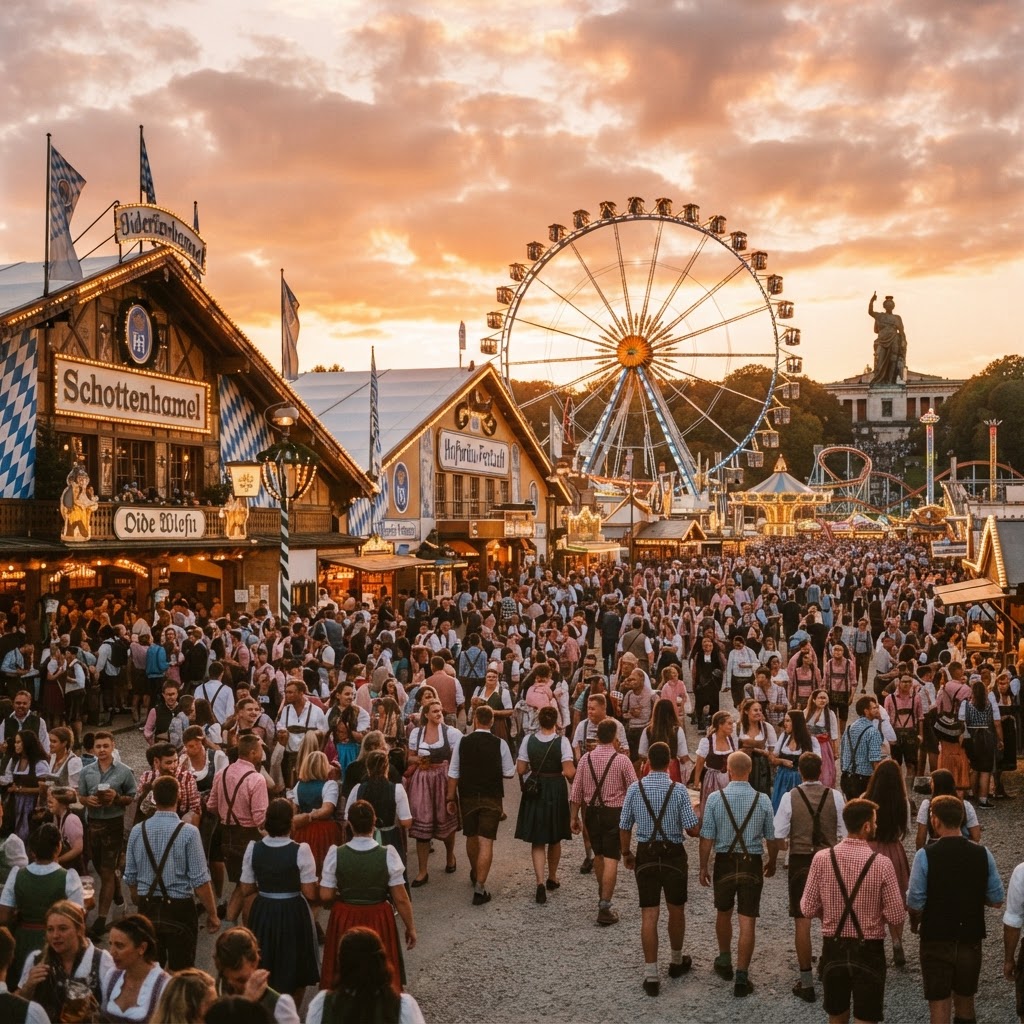
Oktoberfest is the world's largest Volksfest (folk festival), held annually in Munich, Bavaria, Germany. It runs for approximately 16–18 days from mid-September to the first Sunday in October — despite its name, most of the festival takes place in September. The festival takes place on the Theresienwiese (the 'Theresa's meadow', named after the Princess Therese whose wedding was celebrated there), a 42-hectare open ground in the Ludwigsvorstadt district of Munich. The site is known to locals simply as 'die Wiesn'.
The festival attracts over six million visitors annually from around the world, who consume approximately seven million litres of beer, hundreds of thousands of roast chickens and pork knuckles, and vast quantities of pretzels and sausages.
The Origins
Oktoberfest originated on 12 October 1810, when the citizens of Munich were invited to celebrate the wedding of Crown Prince Ludwig of Bavaria (who became King Ludwig I in 1825) to Princess Therese of Saxony-Hildburghausen. The five-day celebration was held on the fields in front of the city gates, which were thenceforth named the Theresienwiese in honour of the Crown Princess. The festivities concluded with a horse race, which was repeated the following year, and the tradition of an annual festival was born.
The festival was extended over the decades: agricultural shows were added (and continue to this day as a feature of the festival), carnival rides were introduced (the first carousel appeared in 1818), and the beer stands that had served the early festivals were replaced by large beer halls — the tents that are now the defining feature of the festival.
The Beer Tents
The beer tents are the heart of Oktoberfest. There are 14 large tents and 20 small tents, each operated by one of Munich's six historic breweries (Augustiner, Hacker-Pschorr, Hofbräu, Löwenbräu, Paulaner, and Spaten). The largest tent, the Hofbräu-Festzelt (Hofbräu tent), seats approximately 10,000 people.
The beer served at Oktoberfest — called Wiesn-Bier — must be brewed within the city limits of Munich and must conform to the Reinheitsgebot (the Bavarian Purity Law of 1516, which permits only water, barley, hops, and yeast in beer). It is served in one-litre glass mugs called Maß.
**Tradition and Costume**
Oktoberfest is a celebration of Bavarian cultural tradition. The majority of visitors, both local and international, wear traditional Bavarian costume: Lederhosen (leather breeches) for men, and Dirndl (a traditional dress with bodice, blouse, full skirt, and apron) for women. The annual Trachten- und Schützenzug (costume and riflemen's parade) on the first Sunday of the festival, in which some 8,000 participants in traditional costumes march through the city, is one of the most colourful cultural events in Europe.
The Oktoberfest Grounds
Beyond the beer tents, the Theresienwiese is a full fairground: the Riesenrad (Ferris wheel), the Krinoline (a historic carousel dating to 1924), roller coasters, and dozens of traditional fairground rides and sideshows. The Oide Wiesn (Old Oktoberfest), a section of the festival grounds devoted to traditional costume, historic rides, and old-style beer tents with traditional music, offers a quieter, more historically authentic experience.
Practical Information
Oktoberfest is free to enter during the week; a small fee is charged on weekends and public holidays. Entry to the beer tents is free but tables must be reserved in advance (often months ahead) for guaranteed seating. The festival runs from the first Saturday after 15 September to the first Sunday in October. The Theresienwiese is a 10-minute walk from Munich Central Station (Hauptbahnhof) and is served by U-Bahn lines U3 and U6 (Theresienwiese and Goetheplatz stations). Reference: [Oktoberfest Official](https://www.oktoberfest.de/en/)
Reference Links:
- Oktoberfest Official: oktoberfest.de/en/
- Munich Tourism: muenchen.travel/en
- Oktoberfest History: oktoberfest.de/en/magazine/tradition/the-history-of-oktoberfest
- Reinheitsgebot (German Purity Law): oktoberfest.de/en/magazine/tradition/reinheitsgebot
- Bavarian Tourism: travel.bayern
- Deutsche Bahn (trains): bahn.com

Continue Reading