Culture
New Orleans and the Soul of Jazz: A Cultural Pilgrimage
Jazz was born in New Orleans — in the Congo Square gatherings, the Storyville clubs, and the street parades of the early 20th century. The city remains its irreplaceable home.
Jazz is an American creation — arguably the most significant contribution the United States has made to world music — and New Orleans is where it was born. Not metaphorically, not approximately, but literally: in the specific conditions of early 20th-century New Orleans, with its unique confluence of African, Caribbean, French, Spanish, and Creole cultures, a music emerged that would become the foundation of virtually all popular music that followed.
**The Origins**
The history begins in Congo Square (now Louis Armstrong Park), where enslaved Africans were permitted to gather on Sundays to play music, sing, and dance — a practice unique to New Orleans in the antebellum South and one that preserved African musical traditions that elsewhere were lost. The rhythmic complexity and call-and-response patterns of African music fused with European harmonic structures and the blues sensibility of the Deep South to produce something genuinely new.
The National Park Service's Jazz National Historical Park (nps.gov/jazz) on N. Peters Street documents this history with remarkable depth and provides free ranger-led tours of historic jazz sites.
The early development of jazz as a formal music is most associated with cornetist Buddy Bolden, active in the 1890s and early 1900s, and with the Storyville district — the city's officially sanctioned red-light district, where clubs operated around the clock and musicians had steady, paying work. Storyville was demolished in 1917 at the insistence of the US Navy, scattering musicians northward to Chicago and beyond and beginning jazz's spread across America.
**Where to Hear Jazz Today**
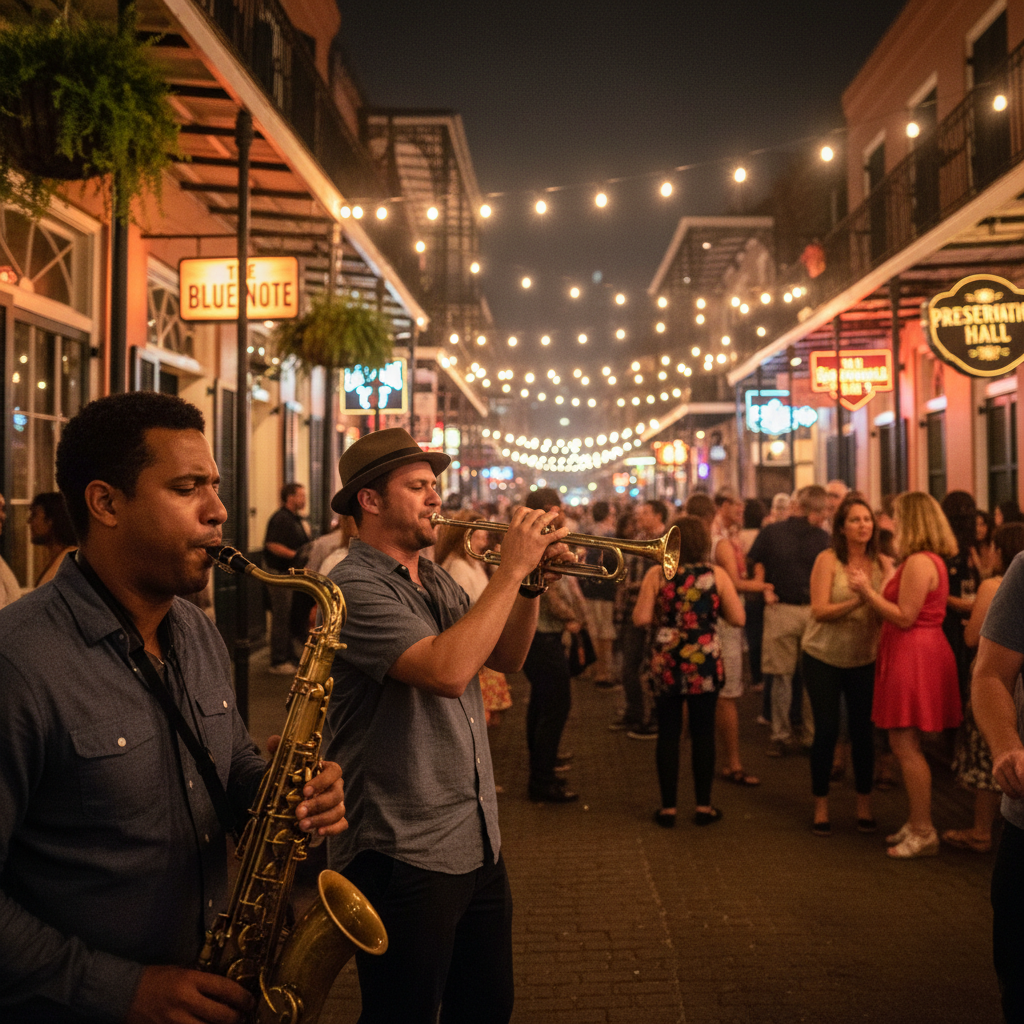
Frenchmen Street in the Marigny neighbourhood — not Bourbon Street, which caters primarily to tourists — is where New Orleans' living jazz culture resides. The block between Chartres and Royal streets contains the highest concentration of serious jazz venues in the city.
Preservation Hall (preservationhall.com) on St. Peter Street in the French Quarter has been presenting traditional New Orleans jazz since 1961. Shows run nightly at 6pm, 8pm, and 10pm in an intentionally preserved, un-air-conditioned space — wooden benches, standing room, and musicians playing in the oldest tradition. It is an essential experience.
Snug Harbor Jazz Bistro (snugjazz.com) on Frenchmen Street presents the most sophisticated jazz programming in the city, with two shows nightly. Ellis Marsalis performed here regularly; the Marsalis family connection to New Orleans jazz runs deep.
The Spotted Cat Music Club (spottedcatnola.com), also on Frenchmen Street, presents free shows every day and night — no cover, no reservations, a rotating roster of extraordinary musicians. The level of musicianship on any given Tuesday night is astonishing.
**The Jazz Museum**
The New Orleans Jazz Museum (nolajazzmuseum.org) at the Old US Mint on Esplanade Avenue is the authoritative institutional home of jazz history in the city, with instruments, recordings, and archival materials spanning the music's entire history. Free admission on Tuesdays.
**The New Orleans Jazz & Heritage Festival**
Jazz Fest (nojazzfest.com) takes place annually across the last weekend of April and first weekend of May at the New Orleans Fairgrounds. Now in its sixth decade, it presents not only jazz but gospel, blues, Cajun, zydeco, R&B, and rock across a dozen stages. It remains one of the great music festivals on earth.
To come to New Orleans for the music — to hear a second line parade move through the streets on a Sunday afternoon, to stand in Preservation Hall as the band plays 'St. James Infirmary', to watch a trumpet player improvise at 2am on Frenchmen Street — is to touch something that belongs to the most important story in American cultural history.
Continue Reading