Culture
The Louvre: How to Experience the World's Greatest Museum
Eight departments, 35,000 works on display, and nine million visitors a year — the Louvre rewards those who come with a plan and leave the crowds behind.
The Louvre is not a museum you simply visit. It is a civilisation you enter — 73,000 square metres of former royal palace housing one of the most extraordinary accumulations of human creative achievement ever assembled in a single building. With over 35,000 works on permanent display across eight curatorial departments, it demands strategy, patience, and a willingness to let go of the idea that you can see everything.
You cannot. And that is precisely the point.
**Before You Arrive**
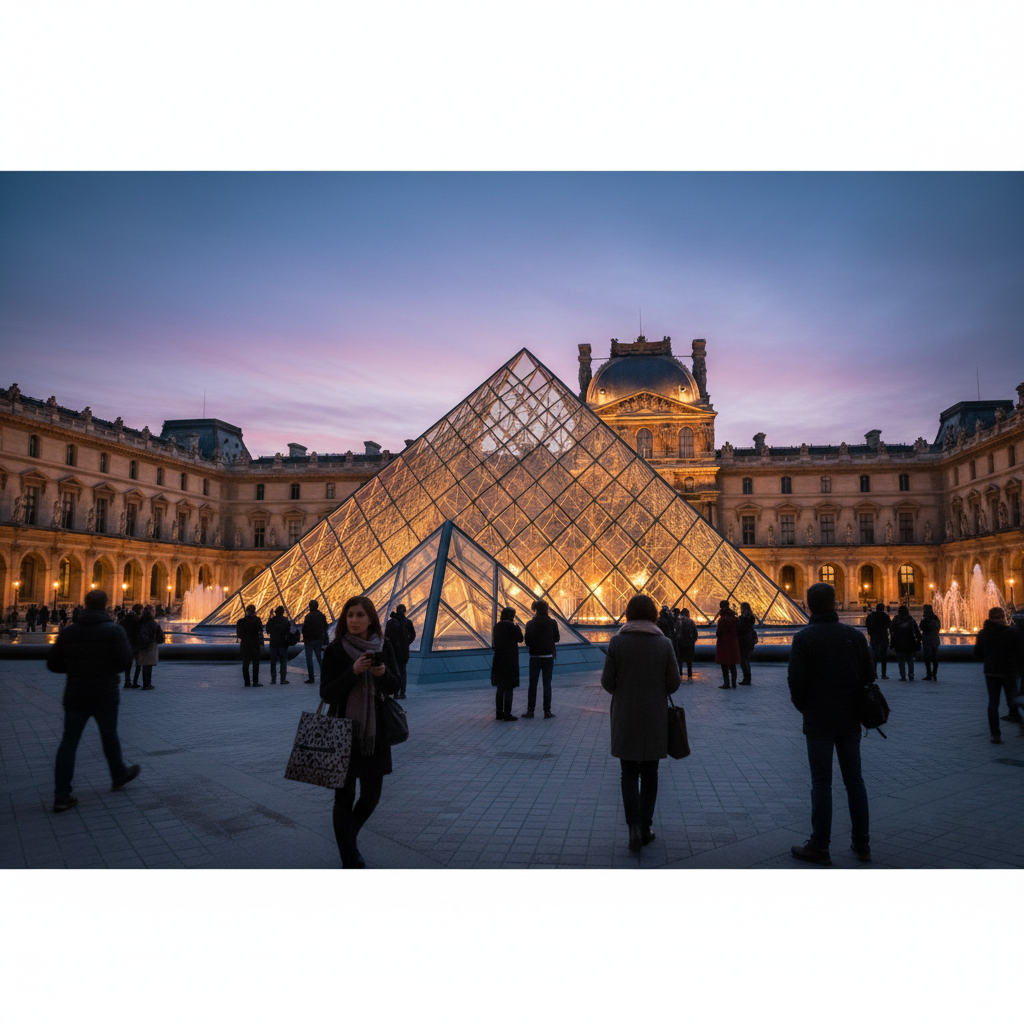
Book timed-entry tickets in advance at louvre.fr — this is non-negotiable. Walk-up queues at the pyramid entrance can exceed two hours even on quieter weekdays. Book for the first slot of the day (9am) or the Wednesday and Friday late openings, when the museum stays open until 9:45pm and attendance is significantly lower. The Carrousel du Louvre underground entrance, accessible from the Rue de Rivoli, is also considerably less congested than the glass pyramid.
**The Eight Departments**
The collections are divided into eight curatorial departments: Egyptian Antiquities, Greek, Etruscan and Roman Antiquities, Near Eastern Antiquities, Islamic Art, Sculptures, Decorative Arts, Paintings, and Prints and Drawings. The Paintings department — with over 7,500 works — is the largest and contains the museum's most celebrated masterpieces.
**What to Seek**
The Mona Lisa (Salle 711, Denon Wing, 1st floor) is smaller and more distant than you expect — but the room it occupies is extraordinary, dominated by Veronese's vast 'Wedding at Cana' on the opposite wall, a painting most visitors ignore in their rush toward Leonardo. Spend time with Veronese first.
The Winged Victory of Samothrace (Daru staircase, Denon Wing) — a Hellenistic masterwork of around 190 BCE — is arguably the greatest single sculpture in the museum. It has no head, no arms, and is breathtaking. The Venus de Milo (Salle 346, Sully Wing) remains a wonder of Hellenistic carving; arrive at opening when the room is quiet.
In the Paintings department, Vermeer's 'The Lacemaker', Delacroix's 'Liberty Leading the People', and Caravaggio's 'The Death of the Virgin' reward extended contemplation. The Dutch Masters rooms in the Richelieu Wing are consistently uncrowded and contain extraordinary work.
**The Rooms Everyone Misses**
The Apartments of Napoleon III in the Richelieu Wing — Second Empire interiors of extraordinary opulence, completely intact — are among the most spectacular rooms in Paris and receive a fraction of the foot traffic of the Mona Lisa corridor.
The Islamic Art galleries (opened 2012, Cour Visconti, Denon Wing), housed under an extraordinary undulating gold and white latticed roof designed by Mario Bellini and Rudy Ricciotti, contain 3,000 works spanning 13 centuries and are consistently undervisited.
**Practical Considerations**
Allow a minimum of three to four hours for a focused visit. The Café Marly (cafeamarly.com), housed in the Richelieu arcade overlooking the pyramid, is the museum's most atmospheric dining option — the terrace view over the glass pyramid is one of the great Parisian restaurant views. Book ahead for lunch.
The museum is closed on Tuesdays. Admission is free on the first Friday evening of each month for visitors under 26, and free for all EU citizens under 26 year-round.
The Louvre is not a box to check. It is a place to return to — to know better each time, to find new rooms, new works, new relationships between objects made three thousand years apart that somehow illuminate each other across the centuries.
Continue Reading