Culture
Jazz at Lincoln Center: How New York Became the World Capital of Jazz
From the speakeasies of Harlem to the concert halls of Lincoln Center — New York's relationship with jazz is the most significant story in American cultural history, and it is still being written.
No city has a deeper relationship with jazz than New York. The music was born in New Orleans at the turn of the 20th century — in the brothels and dance halls of Storyville, in the brass band funeral traditions of the Black community, in the Creole culture of the Mississippi Delta — but it came of age in New York. It was in Harlem in the 1920s and 1930s that jazz developed its most complex and sophisticated form; it was in the clubs of 52nd Street ('Swing Street') in the 1940s that bebop was invented; it was in Greenwich Village in the 1950s that the modal and free jazz innovations of Miles Davis, John Coltrane, and Ornette Coleman transformed the music again. The New York music industry infrastructure — the recording studios, the clubs, the concert halls, the critics, the audience — made New York the capital of jazz, and it remains so.
**Jazz at Lincoln Center**
Jazz at Lincoln Center (jazz.org) is the world's largest not-for-profit jazz organisation, founded in 1987 as a constituent of Lincoln Center for the Performing Arts. Under artistic director Wynton Marsalis — himself one of the most significant jazz musicians of the past forty years — the organisation has grown from a presenting series to a global cultural institution with its own performance complex, education programmes, and an international touring arm.
The home of Jazz at Lincoln Center is the Frederick P. Rose Hall, occupying the fifth floor of the Time Warner Center at Columbus Circle — opened in 2004, it was the first facility in the world built specifically for jazz performance. The complex contains three performance venues:
The Rose Theater (capacity 1,100): The main concert hall, with exceptional acoustics and sightlines, hosts the Jazz at Lincoln Center Orchestra's subscription series and major guest presentations. The JLCO, led by Marsalis, plays approximately 100 concerts per year across genres from Ellington to newly commissioned works.
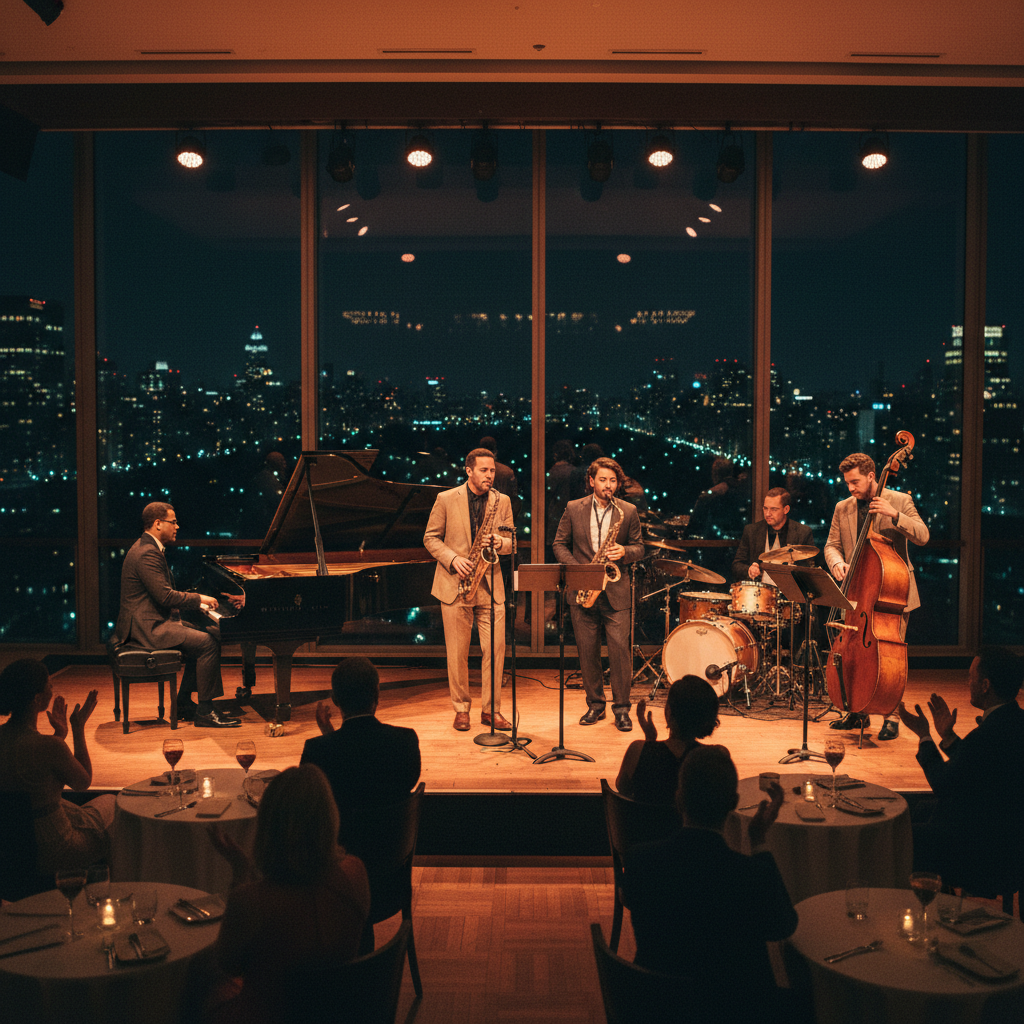
The Allen Room (capacity 500): A theatre with floor-to-ceiling glass walls overlooking Central Park and the Manhattan skyline — one of the most dramatic performance venues in the world. The glass backdrop, with the park below and the city rising beyond it, creates an atmospheric context that no other concert venue in New York can match.
Dizzy's Club (capacity 140): Named in honour of Dizzy Gillespie, this intimate club presents jazz seven nights a week, 365 nights a year. The programming ranges from established masters to rising figures across all jazz traditions; the late-night sets on weekends are among the finest small-room jazz experiences in New York. Reservations at jazz.org/dizzys-club; tickets typically range from $35–$60 with a minimum food and drink order.
**The Jazz Calendar**
Beyond Jazz at Lincoln Center, New York's jazz calendar is dense and extraordinary year-round. The Village Vanguard (villagevanguard.com) — the basement club at 178 Seventh Avenue South in Greenwich Village, opened by Max Gordon in 1935 — is the most historically important jazz club in the world. The Monday night residency of the Vanguard Jazz Orchestra, which has played every Monday since 1966, is an essential New York cultural experience. Blue Note (bluenotejazz.com) on West 3rd Street presents more mainstream and international bookings with higher production values and a larger room. Smalls Jazz Club (smallslive.com) in the West Village is the most authentic and democratic of the major venues — low covers, late sets, and a devotion to bebop and post-bop that has made it a destination for visiting jazz musicians from every country.
**The Broader Jazz History**
For the jazz cultural pilgrim, the geography of New York's jazz history is itself a tour. The Cotton Club — where Duke Ellington's orchestra performed its landmark radio broadcasts in the late 1920s and early 1930s — was in Harlem at 142nd Street and Lenox Avenue. The Apollo Theater (apollotheater.org) at 253 West 125th Street, whose Amateur Night created the careers of Ella Fitzgerald, Billie Holiday, and James Brown, remains one of New York's living cultural institutions, still programming music and comedy. The National Jazz Museum in Harlem (jazzmuseuminharlem.org), at 58 West 129th Street, documents the music's history through recordings, photographs, and instruments with programmes and exhibitions that are free or low-cost.
For an understanding of what jazz is, what it was, and what it continues to become, no city offers the depth of New York — and no institution presents it more completely than Jazz at Lincoln Center.



Continue Reading


