Culture
Holi: India's Festival of Colors and the Subcontinent's Most Joyful Celebration
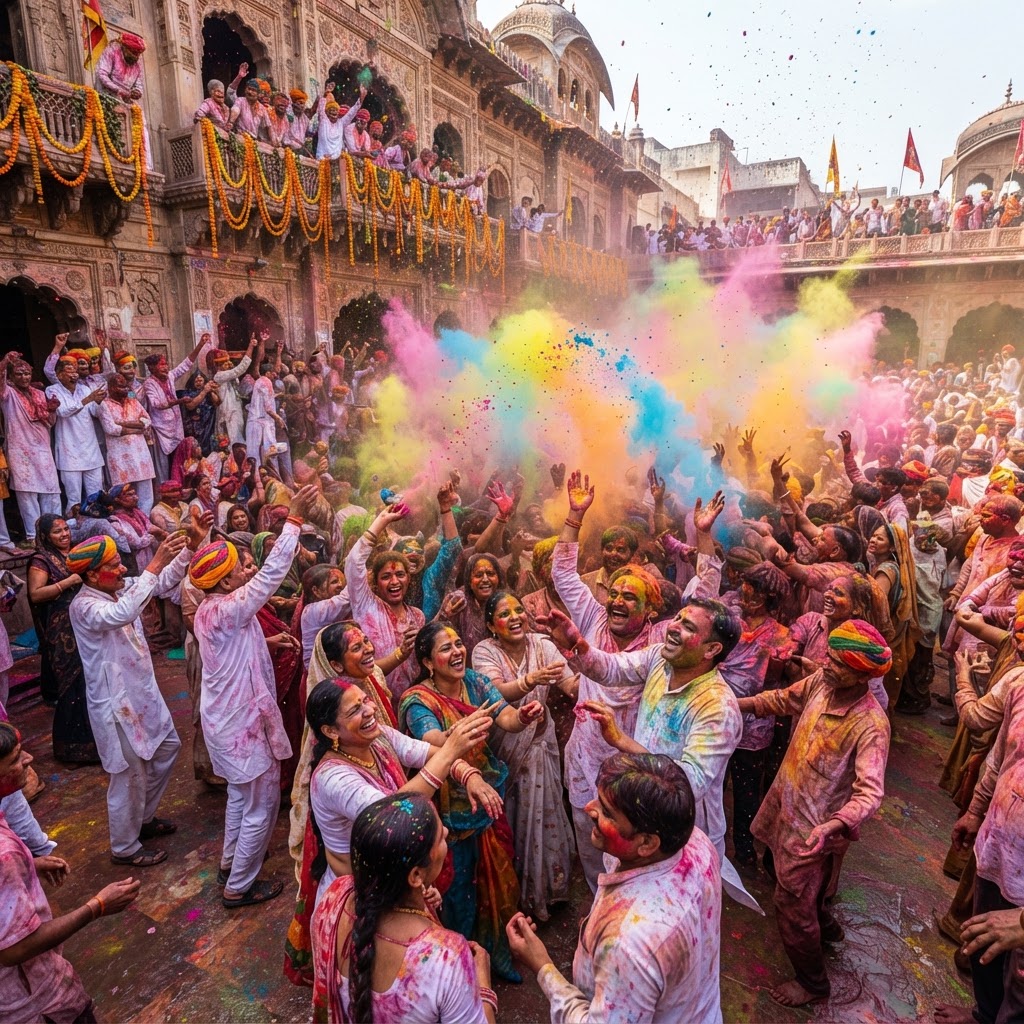
Holi, the ancient Hindu festival celebrated across India and the diaspora, marks the arrival of spring and the triumph of good over evil. From the bonfires of Holika Dahan to the clouds of gulal (colored powder), Holi is a joyous, boundary-breaking celebration that unites communities in color.
Holi is one of the most ancient and joyous festivals in the Hindu calendar, celebrated across India and the global Hindu diaspora. Known as the 'Festival of Colors' or the 'Festival of Spring,' Holi marks the end of winter, the arrival of spring, and the triumph of good over evil. In 2026, Holi begins on the evening of Tuesday, 3 March and continues through Wednesday, 4 March, timed to the full moon (Purnima) of the Hindu lunar month of Phalguna.
Origins and Mythology
Holi's origins are ancient, predating the Gupta period (4th–6th centuries AD), with references found in ancient texts including the Purva Mimamsa Sutras, the Narada Purana, and the Bhavishya Purana. The festival draws on two principal mythological traditions:
The legend of Holika and Prahlad — the most widely known origin story. Hiranyakashipu, a demon king, grew arrogant and demanded that he be worshipped as a god. His son Prahlad refused, remaining devoted to Vishnu. Enraged, Hiranyakashipu asked his sister Holika — who had been granted a boon making her immune to fire — to sit in a pyre with Prahlad on her lap. But as the fire blazed, Prahlad prayed to Vishnu and emerged unscathed, while Holika burned to ashes. The bonfire of Holika Dahan, lit the night before Holi, commemorates this victory of devotion and righteousness over evil.
The legend of Radha and Krishna — the playful, joyous aspect of Holi. According to tradition, the dark-skinned Krishna was jealous of the fair-skinned Radha and, on the advice of his mother Yashoda, playfully smeared colored powder on Radha's face. This divine play (lila) is the origin of the tradition of throwing colors (gulal) during Holi.
Holika Dahan: The Night Before
The festival begins on the night before Holi with Holika Dahan (also called Chhoti Holi), when bonfires are lit in communities across India. People gather around the fire to sing, dance, and throw offerings — wood, dried leaves, coconuts, and grains — into the flames, symbolically burning away the negativity and impurities of the past year. In some regions, effigies of Holika are placed atop the pyre.
In the Braj region of Uttar Pradesh — Mathura, Vrindavan, Nandgaon, and Barsana, the traditional homeland of Krishna and Radha — Holi celebrations extend over several days and follow unique local traditions. The Lathmar Holi of Barsana, where women playfully beat men with sticks, is among the most famous regional variations.
Rangwali Holi: The Day of Colors
On the morning of Rangwali Holi (the main day), streets, parks, and temple courtyards across India erupt in color. Revelers of all ages playfully throw gulal — finely ground colored powder in vibrant shades of pink, yellow, blue, green, red, and purple — at each other. Water pistols (pichkaris), water balloons, and buckets of colored water add to the exuberant chaos. Traditional folk songs are sung to the beat of the dholak drum, and festive foods are shared: gujiya (sweet fried dumplings), thandai (a spiced milk drink, sometimes infused with bhang), malpua (sweet pancakes), and puran poli.
The social significance of Holi is profound. It is a festival that, by tradition, dissolves social boundaries — caste, class, age, and gender distinctions are temporarily set aside as everyone, rich and poor, young and old, participates in the joyful anarchy of color. As the saying goes, 'On Holi, no one is a stranger.'
Regional Celebrations
Holi is celebrated differently across India's regions:
In **Mathura and Vrindavan** (Uttar Pradesh), the celebrations last over a week, beginning with the Phoolon ki Holi (Holi with flowers) at the Banke Bihari Temple, where priests and devotees play Holi with flower petals instead of powder.
In **West Bengal**, Holi is celebrated as Dol Jatra (the swing festival), with images of Krishna and Radha carried in palanquins through the streets. The Basanta Utsav (Spring Festival) at Santiniketan, initiated by Rabindranath Tagore in the 1920s, is a celebrated cultural event featuring music, dance, and traditional dress.
In **Punjab**, Sikh communities celebrate Hola Mohalla, a three-day festival initiated by Guru Gobind Singh in 1701, featuring martial arts displays, poetry, and music.
In the **Northeast**, particularly in Manipur, the six-day Thabal Chongba festival features traditional dances under the moonlight.
Global Holi
Holi has become a global cultural phenomenon, celebrated in cities across the world with large Indian diaspora communities — from London and New York to Sydney and Dubai. The Festival of Colors has also inspired numerous secular events worldwide, including the Holi Festival of Colors tour in the United States and color runs in cities around the globe.
Reference Links:
- History.com Holi: history.com/articles/holi
- Wikipedia Holi: en.wikipedia.org/wiki/Holi
- Incredible India: incredibleindia.gov.in
- Uttar Pradesh Tourism: uptourism.gov.in
- Ministry of Culture, India: indiaculture.gov.in
Continue Reading