Culture
The Harlem Renaissance: America's Greatest Cultural Flowering
In the 1920s and 1930s, a single neighbourhood in upper Manhattan became the centre of a creative explosion that transformed American art, literature, music, and identity.
The Harlem Renaissance was not a single event, a school, or a movement with declared members and a manifesto. It was something more organic and more remarkable: a convergence of extraordinary talents in a single place at a single moment, producing a flowering of art, literature, music, and intellectual life that transformed the way African Americans were seen — and, crucially, the way African Americans saw themselves.
It lasted, broadly, from the early 1920s to the mid-1930s. Its symbolic capital was Harlem — the neighbourhood in upper Manhattan that had, in the first decades of the 20th century, become the largest urban concentration of Black Americans in the United States, following the Great Migration of hundreds of thousands from the rural South. And its significance extends far beyond any particular period: the writers, artists, and musicians of the Harlem Renaissance established the foundation on which virtually all subsequent African American cultural expression has been built.
**The Context**
The Great Migration brought over a million and a half African Americans north between 1910 and 1930, fleeing the Jim Crow laws, racial violence, and economic oppression of the South. Harlem — developed as a white upper-middle-class neighbourhood and left partially vacant after a speculative real estate collapse — became, through the advocacy of figures like Philip Payton Jr. of the Afro-American Realty Company, available to Black tenants. By 1920, Harlem was the cultural capital of Black America.
The philosopher Alain Locke's landmark anthology *The New Negro* (1925) — available in the collections of the New York Public Library (nypl.org) — defined the movement's intellectual ambitions: a rejection of minstrelsy and degrading stereotypes, an assertion of Black cultural dignity, and the claim that African American art was as sophisticated and significant as any art produced in the Western tradition. The NAACP (naacp.org) and Urban League provided institutional support; Black-owned newspapers like the *Chicago Defender* provided platforms.
**The Literature**
Langston Hughes (1902–1967) is the Renaissance's most enduring literary voice — a poet of jazz rhythms, vernacular speech, and fierce tenderness whose work reads as freshly today as when it was published. His collections *The Weary Blues* (1926) and *Fine Clothes to the Jew* (1927) established a new American poetry.
Zora Neale Hurston (1891–1960) produced in *Their Eyes Were Watching God* (1937) one of the great American novels of the 20th century — a work of such lyricism and formal intelligence that it was rediscovered by a new generation of readers through Alice Walker's advocacy in the 1970s. Her anthropological fieldwork on Southern Black folklore, conducted under Franz Boas at Columbia, was equally significant.
Claude McKay, Countee Cullen, Jean Toomer, and Nella Larsen each produced essential work. The collections of the Schomburg Center for Research in Black Culture (nypl.org/locations/schomburg) in Harlem hold the most comprehensive archive of Harlem Renaissance materials in existence.
**The Visual Art**
Jacob Lawrence's *Migration Series* (1940–41) — 60 small tempera paintings documenting the Great Migration — is among the most significant American artworks of the 20th century. Half of the series is held by the Museum of Modern Art (moma.org) and half by the Phillips Collection (phillipscollection.org) in Washington, DC, which exhibits them together periodically.
Aaron Douglas — the leading visual artist of the Renaissance — developed a distinctive style fusing African motifs with Art Deco geometry. His murals at the Schomburg Center remain in situ and are viewable by the public. Augusta Savage's sculpture, Archibald Motley's paintings of Harlem nightlife, and the photographs of James Van Der Zee document the period with extraordinary vitality.
**The Music**
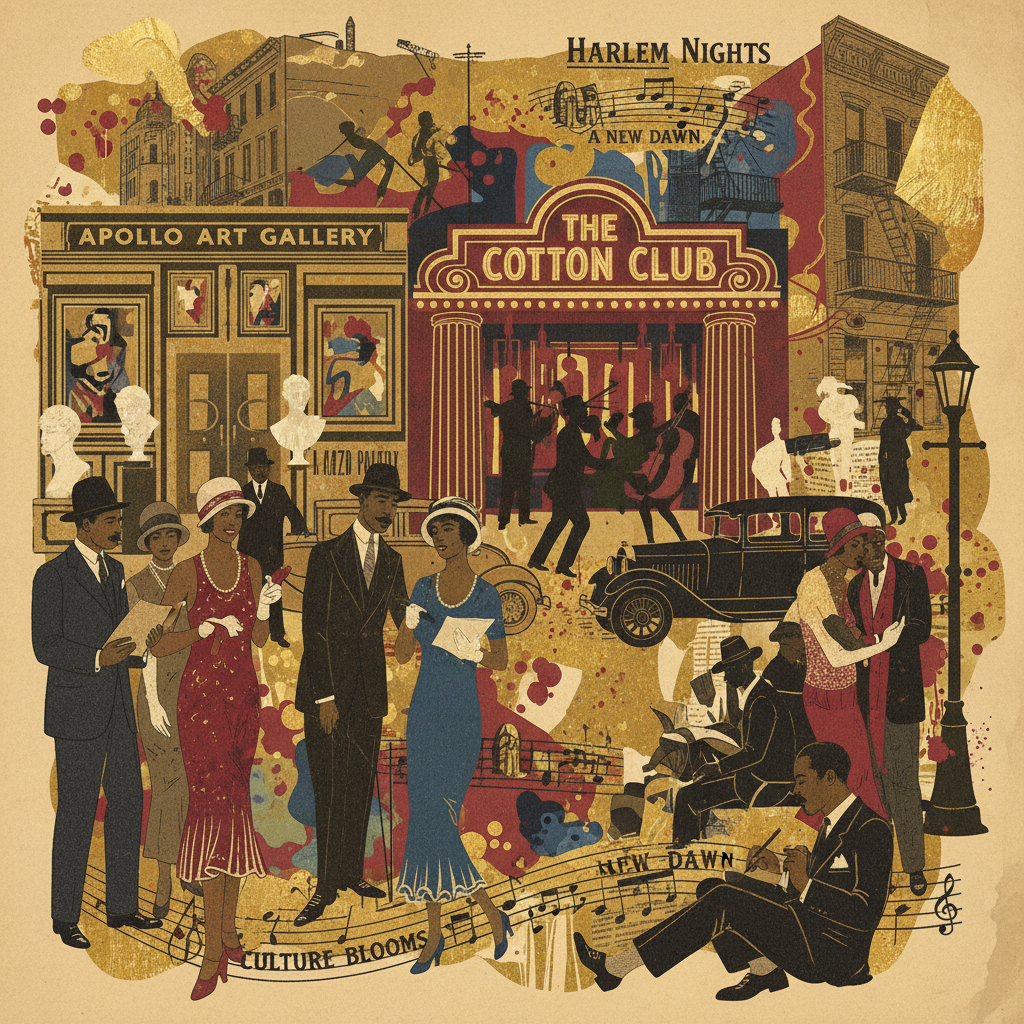
The Renaissance coincided with the golden age of jazz and the Harlem ballroom era. The Cotton Club on Lenox Avenue — segregated, admitting only white audiences while presenting Black performers — was the most glamorous venue of its era, providing Duke Ellington and Cab Calloway with their first major platforms. The Apollo Theater (apollotheater.org) on 125th Street, where Wednesday Amateur Night began in 1934, launched Ella Fitzgerald, Billie Holiday, and James Brown.
**Harlem Today**
Harlem remains a living cultural neighbourhood. The Studio Museum in Harlem (studiomuseum.org) — currently rebuilding at its 125th Street location — is the leading institution devoted to artists of African descent and the spiritual heir of the Renaissance. The Apollo presents year-round programming. The National Jazz Museum in Harlem (jazzmuseuminharlem.org) on Malcolm X Boulevard documents the music's relationship to the neighbourhood's history.
To walk through Harlem with an understanding of what happened here in the 1920s — to see the brownstones where Hughes, Hurston, and Douglas lived and worked, to stand outside the Apollo where Fitzgerald was discovered — is to inhabit one of the richest stories in American cultural history.
Continue Reading