Travel
Hanoi, Vietnam: The Old City, Street Food, and French Colonial Heritage
Hanoi is one of the most atmospheric cities in Asia — a thousand-year-old capital of French colonial boulevards, ancient temples, and what may be the finest street food culture in the world.
Hanoi is the cultural capital of Vietnam and one of the most atmospheric cities in Southeast Asia. Founded in 1010 as Thang Long (Ascending Dragon) by Emperor Ly Thai To, it is one of the oldest continuously inhabited capitals in the world, and its layered history — Chinese, Vietnamese, and French — has produced a city of extraordinary depth and beauty. Unlike Ho Chi Minh City (Saigon), which is Vietnam's commercial capital, Hanoi is the nation's political and cultural heart, a city of tree-lined boulevards, French colonial architecture, ancient temples, and a street food culture that is widely considered the finest in Southeast Asia.
The Old Quarter
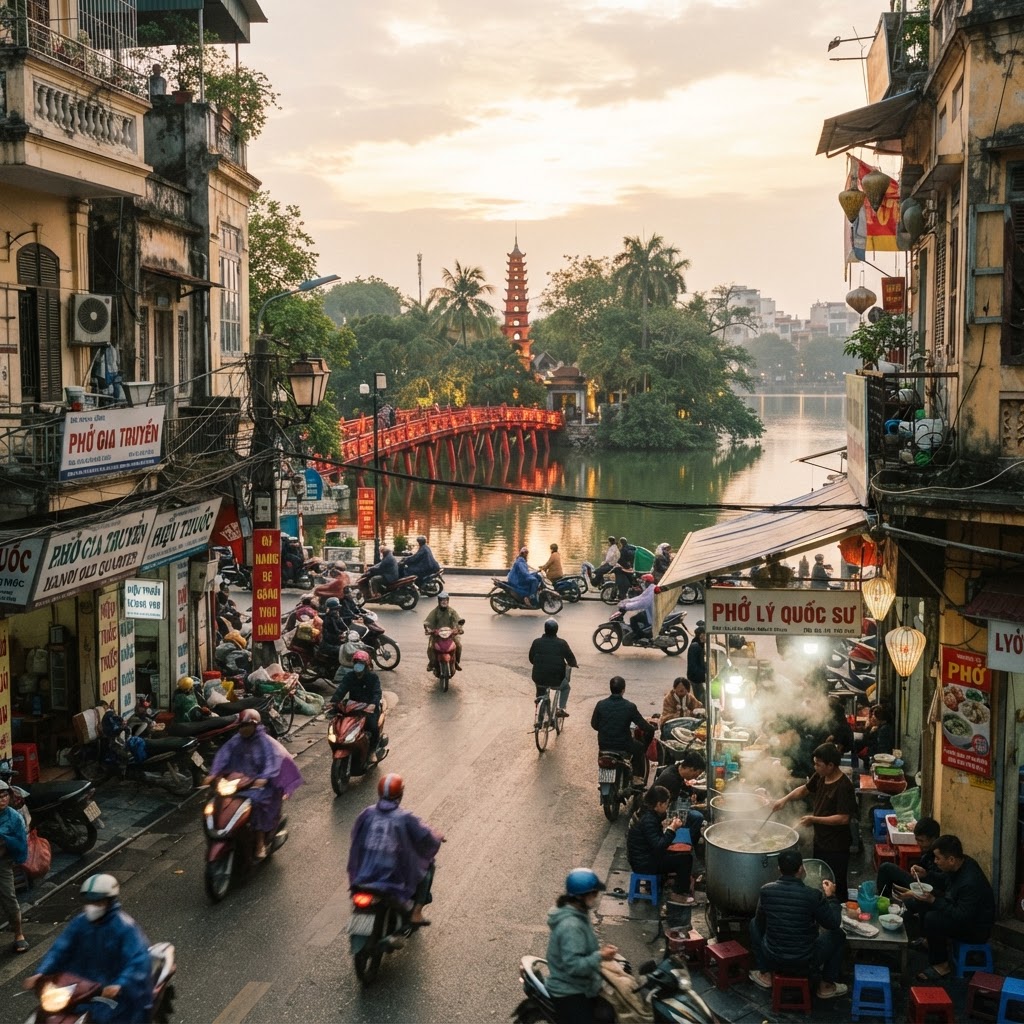
The **Old Quarter** (Pho Co), located at the north end of Hoan Kiem Lake, is the historic commercial heart of Hanoi and one of the most extraordinary urban neighbourhoods in Asia. The quarter dates to the eleventh century and was originally organized into 36 guild streets, each named for the trade practised there — Hang Bac (Silver Street), Hang Bo (Bamboo Basket Street), Hang Ca (Fish Street), Hang Dao (Silk Street), and so on. While many of the original trades have given way to tourism and modern commerce, the quarter retains its labyrinthine layout of narrow streets and tube houses — the tall, narrow buildings that are characteristic of Hanoi's old architecture, built deep rather than wide to minimize the street frontage tax.
The Old Quarter is the centre of Hanoi's legendary street food culture. **Pho** — the Vietnamese noodle soup that is the national dish — originated in Hanoi, and the best pho in Vietnam is found here. **Pho Bat Dan**, **Pho Gia Truyen**, and **Pho Thin Lo Duc** are among the most celebrated pho stalls in the city, each with its own following and each producing a bowl that rivals anything served in a fine restaurant. **Bun cha** — grilled pork patties served with rice vermicelli, herbs, and dipping sauce — is the other iconic Hanoi dish, and **Bun Cha Huong Lien**, the stall where Barack Obama and Anthony Bourdain ate together in 2016, is one of the most famous.
Hoan Kiem Lake and Ngoc Son Temple
**Hoan Kiem Lake** (Lake of the Restored Sword) is the geographic and spiritual centre of Hanoi. The lake takes its name from a fifteenth-century legend in which Emperor Le Loi, who had led the Vietnamese resistance against the Ming dynasty, was given a magical sword by the Golden Turtle God (Kim Qui) to defeat the Chinese. After the victory, the emperor returned the sword to the turtle in the lake. The **Ngoc Son Temple** (Temple of the Jade Mountain), built on a small island in the lake and connected to the shore by the vermilion **The Huc Bridge** (Sunbeam Bridge), is one of the most iconic images of Hanoi.
The Temple of Literature
The **Temple of Literature** (Van Mieu) is Vietnam's first national university and one of its most important cultural sites. Founded in 1070 by Emperor Ly Thanh Tong as a temple to Confucius, the university was established in 1076 as the Quoc Tu Giam (Imperial Academy), the first university in Vietnam and one of the oldest institutions of higher learning in the world. The complex includes five courtyards, with the **Dai Thanh Hall** and the **Courtyard of the Stelae** — which contains 82 stone tablets (steles) mounted on the backs of stone tortoises, recording the names of doctoral laureates who passed the royal examinations between 1442 and 1779.
French Colonial Hanoi
Hanoi was the capital of French Indochina from 1902 until 1954, and the French colonial period left a profound mark on the city's architecture and culture. The **French Quarter** (Ba Dinh and Hai Ba Trung districts), south of Hoan Kiem Lake, contains grand boulevards, yellow-painted colonial villas, and the magnificent **Hanoi Opera House** (Nha Hat Lon Ha Noi), modelled on the Palais Garnier in Paris and completed in 1911. The **Presidential Palace**, a mustard-yellow Beaux-Arts building completed in 1906, was the residence of the Governor-General of French Indochina and is now part of the Ho Chi Minh Mausoleum complex.
The **Sofitel Legend Metropole Hanoi**, opened in 1901, is the grand hotel of Hanoi and one of the great colonial-era hotels of Asia. The hotel has hosted a remarkable cast of historical figures, including Charlie Chaplin and Paulette Goddard (who honeymooned there in 1936), Somerset Maugham, Graham Greene, and Jane Fonda. During the Vietnam War, the hotel's bomb shelter, discovered during renovations in 2011, contained graffiti and artifacts left by journalists and diplomats who took shelter there during the 1972 Christmas Bombing.
Ha Long Bay
No visit to Hanoi is complete without a journey to **Ha Long Bay**, a UNESCO World Heritage Site located about 170 kilometres (3.5 hours by road) east of Hanoi. Ha Long Bay is a vast body of water containing over 1,600 limestone islands and islets, most of them uninhabited and many of them crowned with dense tropical vegetation. The bay was inscribed as a UNESCO World Heritage Site in 1994 for its exceptional scenic beauty. Day trips and overnight cruises on traditional wooden junks are the standard way to experience the bay, and the best cruises visit the Sung Sot (Surprise) Cave, Ti Top Island, and the floating fishing villages.
Vietnamese Cuisine
Hanoi's cuisine is distinct from that of southern Vietnam, with a preference for lighter, more delicate flavours and an emphasis on fresh herbs. In addition to pho and bun cha, the city is famous for **cha ca** — turmeric-marinated fish cooked at the table with dill and spring onions, best experienced at Cha Ca La Vong, the original restaurant that has been serving the dish since 1871. **Banh cuon** — steamed rice noodle rolls with minced pork and mushrooms — is a breakfast staple, and **egg coffee** (ca phe trung), a Hanoi invention made by whipping egg yolks with sweetened condensed milk and pouring over espresso, is one of the most distinctive coffee drinks in the world.
Reference Links:
- Vietnam National Tourism: vietnam.travel
- Sofitel Legend Metropole: sofitel.com
- UNESCO Ha Long Bay: whc.unesco.org/en/list/672
- Temple of Literature: vansu.vn/en/content/detail.493.html
- Hanoi Old Quarter: hoankiem.vn
- Hanoi Opera House: nhatrolonhanoi.com
- Vietnam Travel (Official): vietnam.travel
Continue Reading