Culture
Guggenheim Bilbao: The Building That Transformed a City and Redefined Modern Architecture
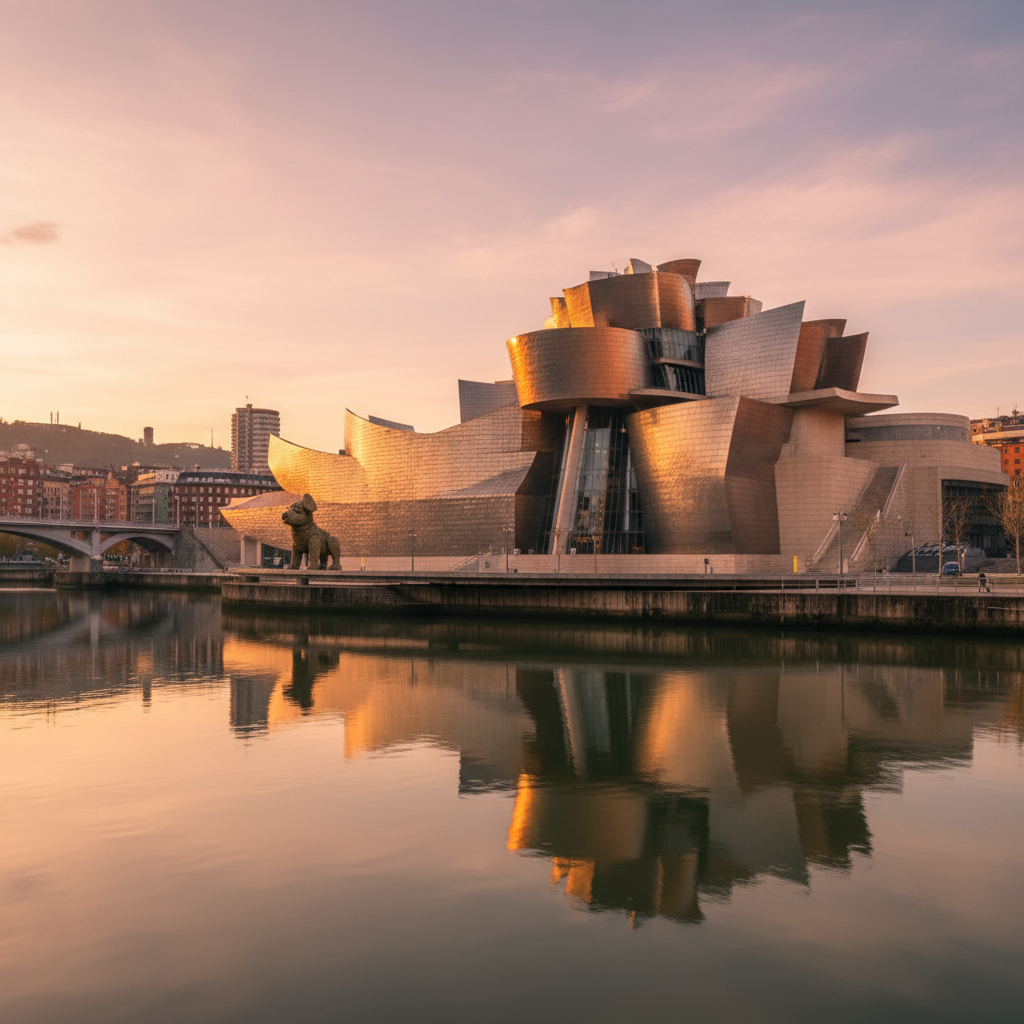
When Frank Gehry's titanium-clad museum opened on the banks of the Nervión in 1997, it did something no building had done before — it single-handedly transformed the cultural and economic fate of an entire city.
In 1991, the city of Bilbao was a post-industrial shell. The Basque Country's principal city had built its prosperity on steel, shipbuilding, and heavy industry; by the late 1980s, those industries had collapsed, unemployment had reached 25%, and the Nervión River — which the city had turned its back on — ran grey with industrial effluent. The Basque regional government made a decision that was, at the time, widely regarded as an act of cultural vanity: they would build a branch of the Solomon R. Guggenheim Foundation and commission Frank Gehry to design it.
The Guggenheim Bilbao opened on 18 October 1997, and within twelve months had attracted 1.3 million visitors, injected an estimated $160 million into the Basque economy, and generated a tax revenue return many times the investment cost. The term coined to describe this phenomenon — the 'Bilbao Effect' — became the most cited concept in urban regeneration theory for the following two decades, as cities around the world attempted (not always successfully) to replicate what a single iconic building had achieved.
**The Architecture**
Gehry's building occupies a 32,700-square-metre site on the south bank of the Nervión, connecting the old city to the riverfront. The structure consists of interconnected volumes of varying shapes and materials: curved organic forms clad in 33,000 titanium panels that change colour across the day from silver to gold to rose depending on the light; limestone blocks for the more orthogonal sections; and glass curtain walls that flood the interior atrium with natural light.
The titanium cladding was not an original specification — Gehry discovered titanium's properties during the design process, when he found that standard stainless steel produced panels too rigid to form the flowing curves he envisioned. Titanium, at 0.38mm thickness, is flexible enough to bend to complex curves, weathers to a warmth that steel cannot achieve, and catches light in a way that changes the building's personality through the day. The structure required 3.2 million CAD computations to model accurately — it was among the first buildings in the world designed entirely through computer modelling.
The building's centerpiece is the Atrium — a 150-foot-tall glass, titanium, and steel central hall that Gehry describes as a 'flower blossoming'; the galleries radiate from it in organic loops. The 130-metre Gallery — one of the longest gallery spaces in the world — was designed to accommodate Richard Serra's *The Matter of Time*, a suite of eight monumental curved steel sculptures that is one of the great permanent installations in contemporary art. Reference: guggenheim-bilbao.eus
**The Collection and Programme**
The Guggenheim Bilbao's permanent collection focuses on contemporary art from the 1960s to the present, with particular emphasis on large-scale works by international artists. Jeff Koons's *Puppy* — a 12-metre-high West Highland terrier constructed of 70,000 living flowers — stands permanently outside the main entrance and has become the most photographed artwork in Spain. Louise Bourgeois's *Maman* — a 9-metre bronze spider — is also installed in the external plazas.
The museum's exhibition programme is internationally renowned. Current and upcoming exhibitions are listed at guggenheim-bilbao.eus/en/whats-on.
**Visiting**
Tickets at guggenheim-bilbao.eus — €16 standard admission, discounts available. The museum is closed on Mondays outside July and August. Bilbao is 45 minutes by bus from Bilbao Airport (BIO), served by Vueling, Iberia, and easyJet from European hubs. The Hotel Miró (hotelmiro.com), directly facing the museum, is the most architecturally interesting accommodation in the city; Marriott's AC Hotel (marriott.com) is the most reliable mid-luxury choice.
Bilbao's Old Town (Casco Viejo) and the pintxos culture of the Siete Calles — the seven streets at the city's historic core, lined with bars serving the Basque version of tapas — are essential companions to the museum visit. The Mercado de la Ribera (mercadodelaribera.net), the largest covered market in Europe, is the ideal lunch destination.



Continue Reading


