Culture
The Gion Matsuri: Kyoto's 1,150-Year-Old Festival of Yasaka Shrine and the Yamaboko Processions
Dating to 869, when Emperor Seiwa ordered prayers to end a plague, Kyoto's Gion Matsuri is one of Japan's oldest festivals. Its Yamaboko processions of towering floats on July 17 and 24 are a UNESCO Intangible Cultural Heritage.
If you want to understand how a city turns faith, craft, and community into a thousand-year tradition, go to Kyoto in July. The Gion Matsuri — the festival of Yasaka Shrine in the Gion district — is one of the most famous and oldest festivals in Japan, a month-long celebration whose roots reach back to the year 869.
**Origins**
As Wikipedia records, in 869, when the people of Kyoto were suffering from a plague attributed to vengeful spirits, Emperor Seiwa ordered prayers to Gozu Tenno, the god of Yasaka Shrine — then known as Gion Temple. The purification ritual, in which 66 halberds were erected to represent each province, was repeated whenever plague returned. By the sixteenth century, the festival had been revived under Oda Nobunaga, and it grew into the magnificent civic celebration seen today. The shrine itself was renamed Yasaka Jinja only in the Meiji era, with the government's separation of Shinto from Buddhism.
**The Yamaboko Junko**
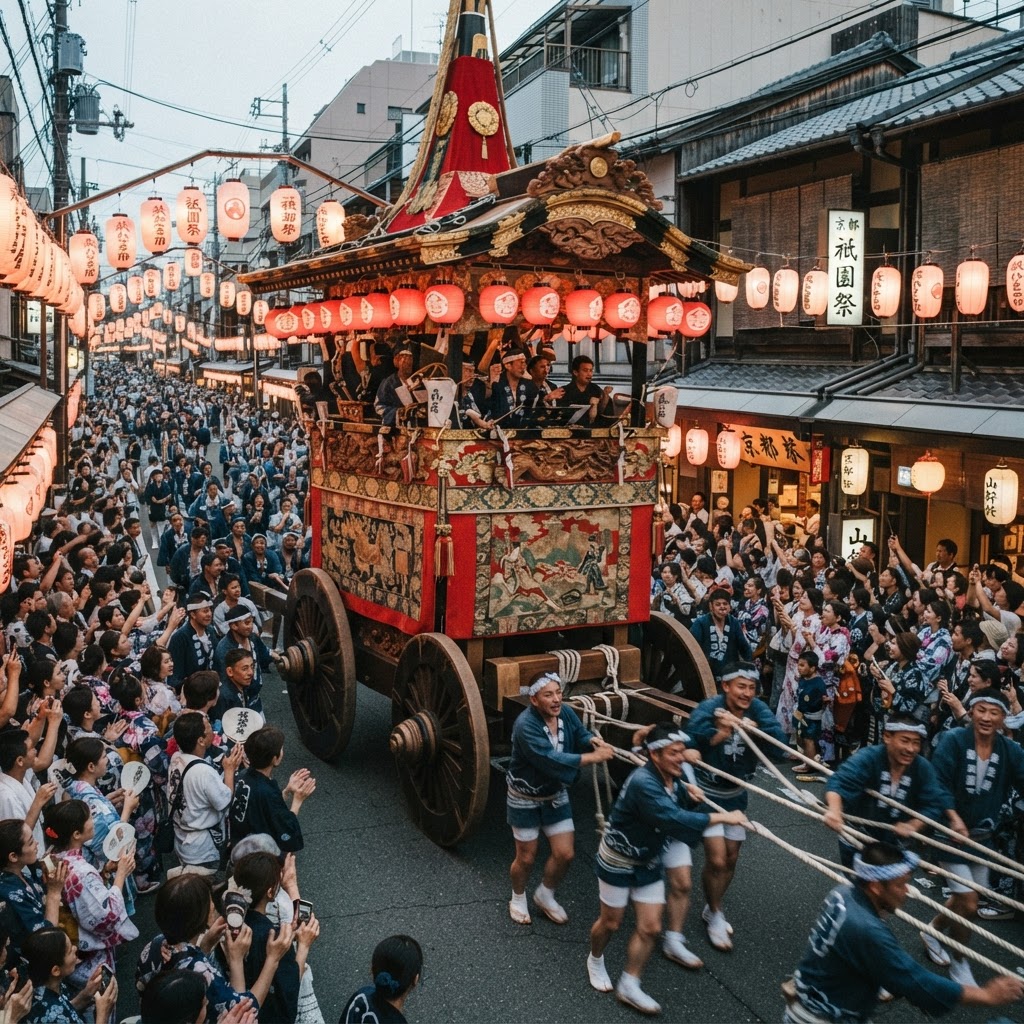
The festival's heart is the Yamaboko Junko — two great processions of floats held on July 17 and July 24. The floats, divided into the tall "hoko" (which can reach 25 meters and weigh up to 12 tons) and the smaller "yama," are collectively called "yamaboko." Each is a mobile museum of textile, carving, and music: musicians sit inside playing drums and flutes, and the floats are pulled through the streets on great wooden wheels. On the evening of July 17, the deities of Yasaka Shrine are carried in portable mikoshi shrines through the neighborhoods to a temporary dwelling, where they are believed to purify the city along the way, before returning to the shrine a week later. In 2009, the Yamaboko processions were inscribed on the UNESCO Representative List of the Intangible Cultural Heritage of Humanity, and they had been listed as an Important Intangible Folk Cultural Property since 1979.
**Why It Matters**
The Gion Matsuri is not a museum piece performed for tourists; it is a living festival maintained by Kyoto's neighborhood associations, who build, fund, and pull the floats each year. For over eleven hundred years, it has joined a city to its shrine, its craft, and its neighbors — a purification made civic, repeated every July.
**References**
- Wikipedia: Gion Matsuri — https://en.wikipedia.org/wiki/Gion_Matsuri
- Gion Festival Yamahoko Association (official) — http://www.gionmatsuri.or.jp/foreign/en/



Continue Reading


