Culture
Day of the Dead: Mexico's Extraordinary Celebration of Life, Death, and Ancestry
Día de los Muertos (Day of the Dead), celebrated across Mexico on November 1 and 2, is one of the most extraordinary cultural festivals in the world — a joyful, colourful celebration in which families welcome the spirits of their deceased ancestors back to earth. It was inscribed by UNESCO as Intangible Cultural Heritage in 2008.
Día de los Muertos (Day of the Dead) is a traditional Mexican holiday celebrated on November 1 and 2, in which families honour and celebrate the lives of their deceased relatives and welcome their spirits back to the world of the living for a brief annual reunion. Unlike the sombre mourning associated with death in many Western cultures, the Day of the Dead is a joyful, colourful, and life-affirming celebration that reflects the indigenous Mesoamerican understanding of death as a natural and continuous part of the cycle of existence.
The holiday was inscribed by UNESCO on the Representative List of the Intangible Cultural Heritage of Humanity in 2008, recognised as 'the most important festivity of the indigenous people of Mexico' and 'one of the oldest and most deeply rooted cultural expressions of the Mesoamerican world.' Reference: [UNESCO — Indigenous festivity dedicated to the dead](https://ich.unesco.org/en/RL/indigenous-festivity-dedicated-to-the-dead-00054)
The Origins
The Day of the Dead has roots in the pre-Columbian Aztec, Toltec, and Nahua cultures, which held that mourning the dead was disrespectful, and that the dead remained members of the community, kept alive in memory and spirit. The Aztecs celebrated a month-long summer festival dedicated to Mictecacihuatl, the goddess of the underworld (known as the 'Lady of the Dead').
After the Spanish conquest of Mexico (1519–21), the Catholic Church sought to assimilate indigenous beliefs into the Christian calendar. The indigenous festival was moved to coincide with the Catholic feasts of All Saints' Day (November 1) and All Souls' Day (November 2) — the days on which the dead are commemorated in the Catholic tradition. The resulting syncretic holiday blends indigenous and European elements in a way that is uniquely Mexican.
The Ofrenda
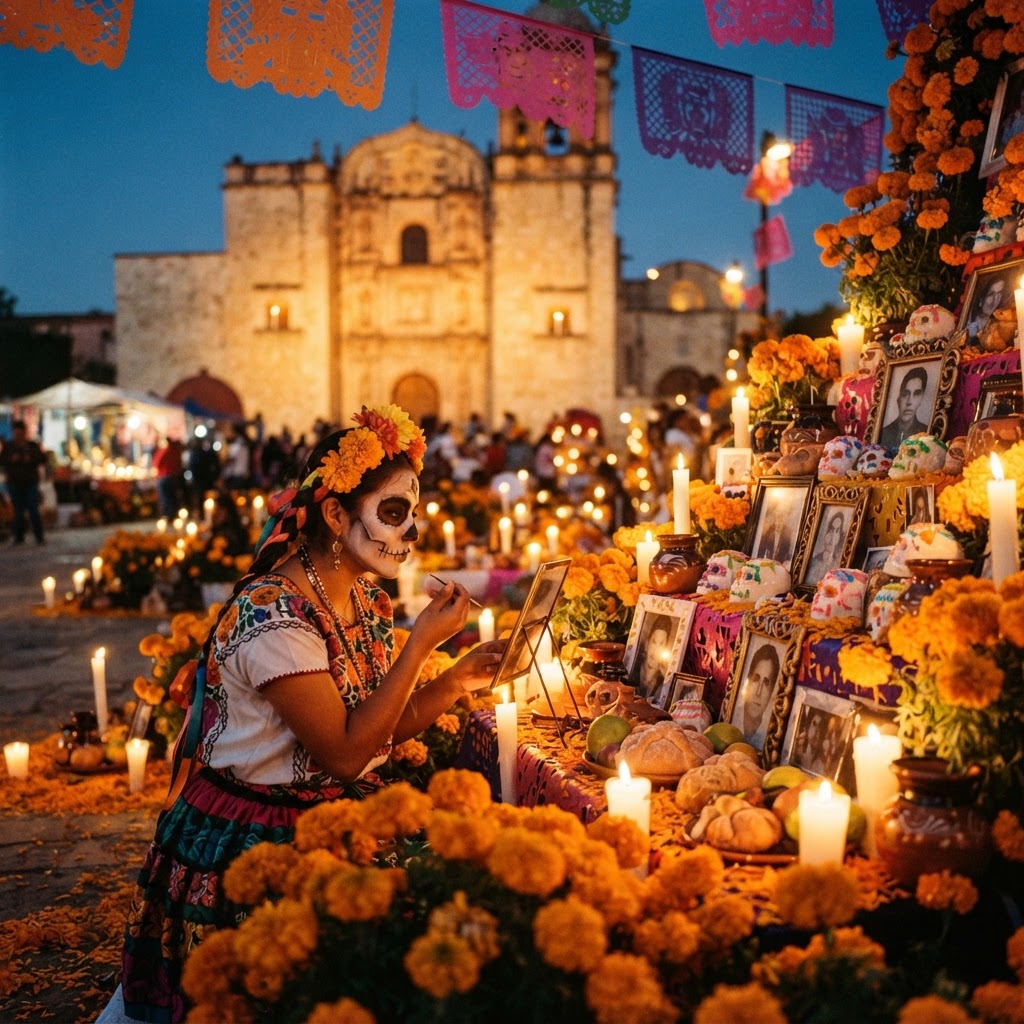
The centrepiece of the Day of the Dead is the ofrenda (altar), built in homes and cemeteries to welcome the returning spirits. The ofrenda is not a site of worship but a welcoming table, laden with the favourite foods, drinks, and possessions of the deceased, photographs, candles, and decorations. The most essential elements include:
**Cempasúchil (marigolds)** — the bright orange Aztec marigold, whose colour and strong scent are believed to guide the spirits home. Paths of marigold petals (caminos de cempasúchil) are laid from the street to the ofrenda.
**Calaveras de azúcar (sugar skulls)** — colourful decorated sugar skulls, often inscribed with the names of the deceased. They are symbols of the holiday's playful engagement with death.
**Pan de muerto (bread of the dead)** — a sweet, eggy bread decorated with bone-shaped pieces of dough, baked only for this season.
**Papel picado** — intricately cut tissue-paper banners in bright colours, hung above the ofrenda and in the streets.
**La Catrina** — the iconic image of the elegant female skeleton, dressed in finery and a feathered hat. The figure originated in the early 20th century in the zinc etchings of the Mexican printmaker José Guadalupe Posada (c. 1910), as a satirical commentary on Mexicans who adopted European aristocratic pretensions. The image was later popularised by the muralist Diego Rivera, who included a Catrina in his mural 'Dream of a Sunday Afternoon in the Alameda Central' (1947).
Oaxaca
The state of Oaxaca, in southern Mexico, is considered the cultural heart of the Day of the Dead celebration. The city of Oaxaca de Juárez and the surrounding villages — particularly Xoxocotlán, Atzompa, and the Zapotec village of Teotitlán del Valle — host the most elaborate and authentic celebrations. The cemeteries are illuminated by thousands of candles, families sit vigil through the night, and comparsas (street processions) with music, dancing, and giant puppets fill the streets. Reference: [Visit México — Day of the Dead](https://www.visitmexico.com)
Practical Information
The Day of the Dead is celebrated across Mexico, but the most memorable experiences are in Oaxaca, Michoacán (particularly the island of Janitzio on Lake Pátzcuaro), and Mexico City (where a monumental parade was introduced in 2015, inspired by the James Bond film 'Spectre'). The holiday takes place on the nights of October 31 through November 2. Hotels in Oaxaca and Mexico City sell out months in advance.
Reference Links:
- UNESCO — Indigenous festivity dedicated to the dead: ich.unesco.org/en/RL/indigenous-festivity-dedicated-to-the-dead-00054
- Visit México: visitmexico.com
- Oaxaca Tourism: oaxaca.travel
- Mexico City Tourism: mexico-city.cdmx.gob.mx
- José Guadalupe Posada (Museum): posada-mexico.com
- Day of the Dead in Mexico: dayofthedead.com
Continue Reading