Fashion
Copenhagen Fashion Week: Scandinavia's Sustainable Style Revolution
In just 20 years, Copenhagen Fashion Week has become the fashion world's 'fifth city' — the global leader in sustainable fashion, with mandatory sustainability requirements that have made it the most ambitious fashion week in the world.
Copenhagen Fashion Week is the fashion world's "fifth city." In just 20 years, it has transformed from a small Nordic fashion event into the global leader in sustainable fashion, earning its place alongside New York, London, Milan, and Paris. What sets Copenhagen apart is not scale or glamour but principle: CPHFW was the first fashion week in the world to make sustainability a mandatory requirement for all brands showing on its official schedule.
**The Copenhagen Revolution**
Copenhagen Fashion Week was founded in 2006. For its first decade, it was a relatively small event showcasing Scandinavian brands to Nordic buyers and press. But beginning around 2017, under CEO Cecilie Thorsmark, Copenhagen Fashion Week began a deliberate transformation. Rather than competing with Paris and Milan on traditional terms, CPHFW positioned itself as the fashion industry's leading voice on sustainability — not as a marketing claim, but as an enforced standard.
The result has been remarkable. In January 2023, CPHFW introduced its Sustainability Requirements — a framework of mandatory minimum standards that all brands on the official schedule must meet. These requirements cover six areas: strategic direction, design, material choices, working conditions, consumer engagement, and show production. Brands must demonstrate compliance before they are allowed to show.
This is not greenwashing. It's a structural change to how a fashion week operates, and it has been widely recognised as the most ambitious sustainability initiative in the global fashion industry. The Guardian called Copenhagen "fashion's fifth city," noting that in 20 years it has "pushed for greener standards and catapulted homegrown talent to global success."
**The Scandinavian Aesthetic**
Copenhagen's influence extends beyond its sustainability leadership. The Scandinavian aesthetic — minimal, functional, refined, and quietly luxurious — has become one of the most influential fashion directions of the 2020s.
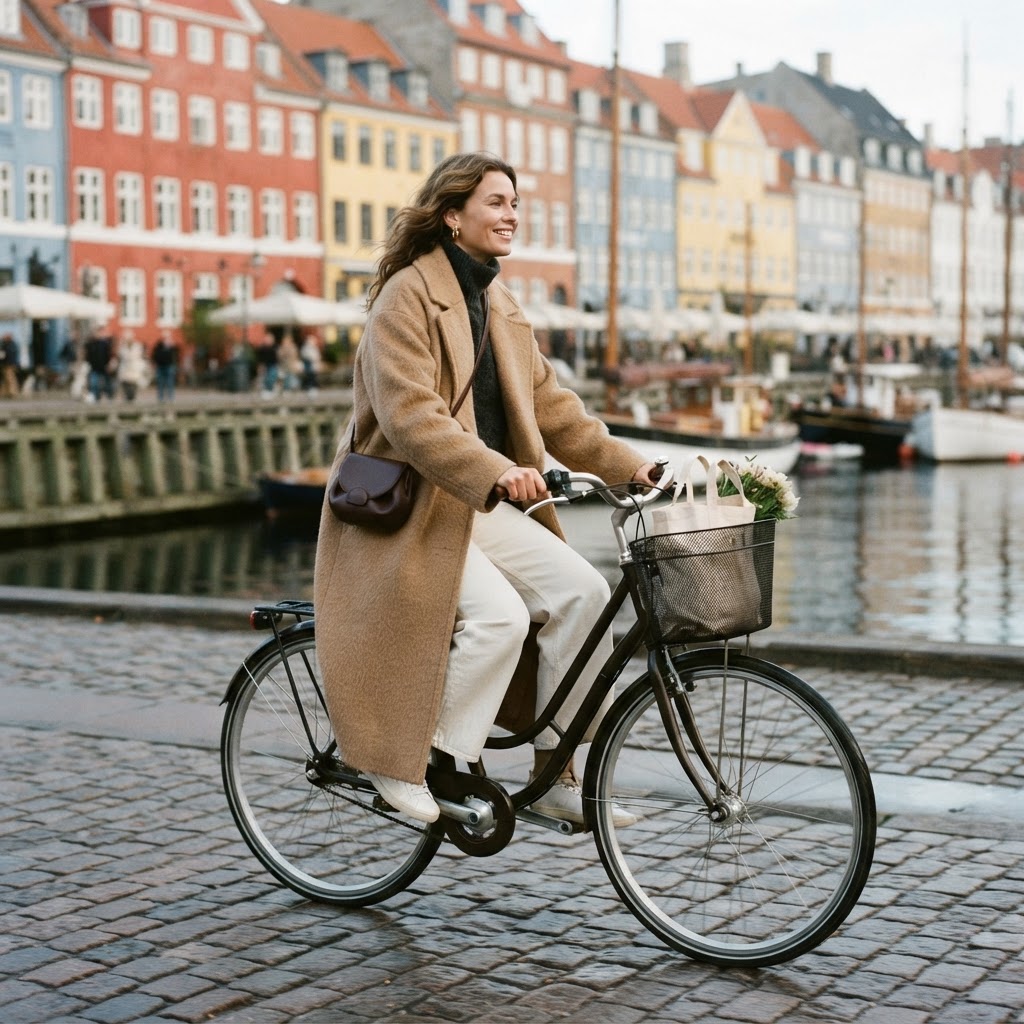
**Minimalism with Warmth** — Unlike the cold minimalism of 1990s fashion, the Scandinavian version is warm, layered, and textured. Think oversized wool coats, cashmere knits, and tailored trousers in earth tones.
**Practical Elegance** — The bicycle is the primary mode of transport in Copenhagen (more bicycles than cars in the city centre), and Copenhagen fashion is designed for cycling. Flat shoes, comfortable silhouettes, and weather-appropriate layering are essential.
**Muted Colour Palettes** — Camel, grey, navy, olive, cream, and soft browns dominate. The colour palette reflects the Nordic landscape — the grey of the Baltic Sea, the brown of autumn forests, the white of snow.
**Quality over Quantity** — The Scandinavian approach to fashion emphasises fewer, better pieces — a natural fit with the sustainability ethos.
**The Brands**
Copenhagen Fashion Week showcases a mix of established Scandinavian brands and emerging designers:
**Ganni** — Perhaps the most internationally successful Copenhagen brand, Ganni (founded in 2000) is known for its playful, colourful, slightly irreverent take on Scandinavian style. While not fully sustainable, Ganni has been transparent about its environmental impact and has pioneered the "Ganni Repeat" rental service.
**Cecilie Bahnsen** — Known for her romantic, sculptural dresses that combine Scandinavian minimalism with French couture techniques, Bahnsen is one of the most celebrated designers to emerge from Copenhagen in recent years.
**Rotate** — A party-wear brand known for its sequined dresses and bold, 1980s-inspired silhouettes.
**Mark Kenly Domino Tan, Stine Goya, Holzweiler, and Norse Projects** are among the other influential Scandinavian brands showing at CPHFW.
**The Street Style Phenomenon**
Copenhagen street style during Fashion Week has become one of the most photographed and influential in the world. The looks are distinctive: oversized tailoring, chunky knitwear, statement outerwear, and — always — flat shoes. The Copenhagen street style aesthetic has influenced how women dress far beyond Scandinavia, proving that sustainability and style are not just compatible but mutually reinforcing.
**The Brunch Connection**
Copenhagen's fashion crowd knows how to do brunch. After a morning show, the cafes of Nørrebro and the Designmuseum Danmark fill with editors in oversized blazers and ballet flats, drinking coffee and — increasingly — something sparkling. A Classic Champagne Mimosa fits the Copenhagen aesthetic perfectly: minimal, elegant, and not trying too hard. For a more Nordic twist, an Elderflower & Mint Spritz Mocktail echoes the city's commitment to both style and sustainability.
**References**
- Copenhagen Fashion Week — https://copenhagenfashionweek.com/
- The Guardian: Copenhagen, Fashion's Fifth City — https://www.theguardian.com/fashion/2023/jan/30/copenhagen-fashion-week-sustainability
- Vogue: Inside Copenhagen Fashion Week — https://www.vogue.com/fashion-weeks/copenhagen
- BoF: Copenhagen Fashion Week's Sustainability Requirements — https://www.businessoffashion.com/articles/sustainability/copenhagen-fashion-week-sustainability-requirements

Continue Reading