Wellness
The Circadian Code: Light, Timing, and the Science of Your Body Clock
The circadian rhythm governs every physiological process in the body. The research of Dr. Satchin Panda at the Salk Institute shows that timing — of light, food, and sleep — may matter as much as the behaviours themselves.
The circadian rhythm — the body's internal 24-hour clock — governs virtually every physiological process in the human body, from hormone release and body temperature to sleep-wake cycles and metabolism. The science of how these rhythms work, and how disrupting them affects health, has become one of the most important fields in modern biomedical research.
The leading figure in this field is Dr. Satchin Panda, a professor at the Salk Institute for Biological Studies in La Jolla, California, and a leading researcher in the genetics of circadian rhythms. Dr. Panda's research has demonstrated that the timing of food intake — not just its content — has profound effects on metabolic health, and his 2018 book 'The Circadian Code' (Avery) brought these findings to a general audience.
The Science of the Body Clock
The master clock of the body is the **suprachiasmatic nucleus (SCN)** — a tiny cluster of approximately 20,000 neurons in the hypothalamus of the brain. The SCN receives direct input from the retina and synchronises itself to the light-dark cycle of the environment. From the SCN, timing signals are distributed to peripheral clocks in virtually every organ and tissue of the body, creating a coordinated system of circadian rhythms.
At the molecular level, the circadian clock is driven by a set of 'clock genes' — including CLOCK, BMAL1, PER, and CRY — that produce proteins in a feedback loop that takes approximately 24 hours to complete. The discovery of the molecular mechanisms of the circadian clock earned the 2017 Nobel Prize in Physiology or Medicine, awarded to Jeffrey C. Hall, Michael Rosbash, and Michael W. Young.
Light and Timing
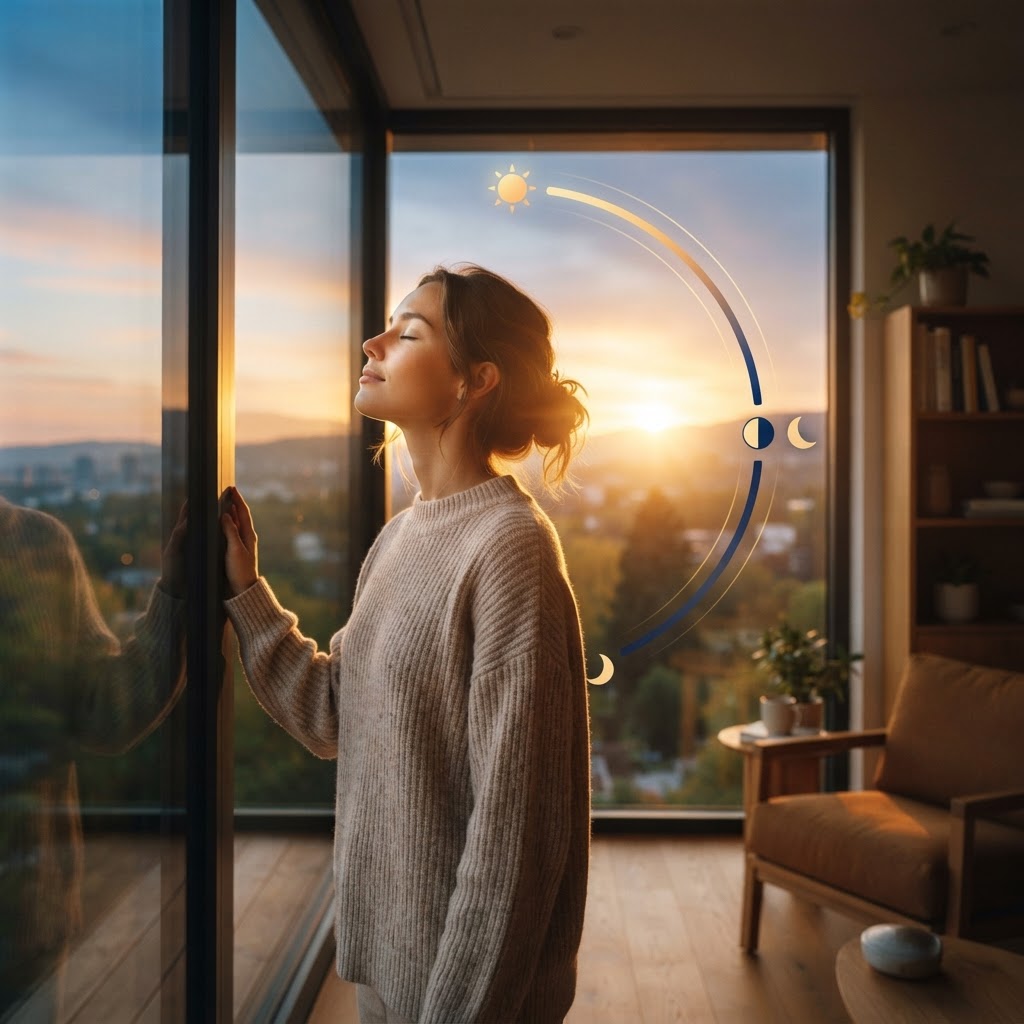
The most powerful synchroniser of the circadian clock is **light**. Morning light, received by specialised photoreceptors in the retina (intrinsically photosensitive retinal ganglion cells, which contain the photopigment melanopsin), signals the SCN to suppress melatonin production and promote alertness. Evening light — particularly the blue light from screens — delays melatonin onset and disrupts sleep.
Dr. Panda's research at the Salk Institute has demonstrated that **time-restricted eating** — confining food intake to a window of 8–12 hours aligned with the active phase of the day — can have profound metabolic benefits, independent of caloric intake. A 2021 study from the Salk Institute found that time-restricted eating reshapes gene expression throughout the body, synchronising circadian rhythms across multiple organ systems.
The Health Consequences of Disruption
Circadian disruption — caused by shift work, jet lag, irregular sleep schedules, and late-night eating — has been associated with a wide range of health problems. A 2017 review published in PubMed found that circadian rhythm disruption is linked to accelerated aging and increased risk of metabolic syndrome, cardiovascular disease, and certain cancers. The World Health Organization's International Agency for Research on Cancer has classified shift work that involves circadian disruption as a probable carcinogen (Group 2A).
Practical Guidance
Aligning daily behaviours with circadian rhythms can significantly improve health:
**Morning light exposure** — Get 10–30 minutes of outdoor light within an hour of waking. This is the single most powerful intervention for synchronising the circadian clock.
**Consistent sleep schedule** — Go to bed and wake up at the same time every day, even on weekends. Variation of more than an hour disrupts the clock.
**Time-restricted eating** — Confine food intake to a window of 8–12 hours, ideally aligned with daylight hours (e.g. eating between 8am and 6pm).
**Evening light management** — Reduce exposure to bright light and blue light (from screens) for 2–3 hours before bed. Red light and amber light have minimal effect on melatonin.
Reference Links:
- Dr. Satchin Panda (Salk Institute): salk.edu/scientist/satchidananda-panda
- The Circadian Code (book, 2018): penguinrandomhouse.com
- Salk Institute — Time-Restricted Eating Research: salk.edu/news-release/time-restricted-eating-reshapes-gene-expression-throughout-the-body/
- PubMed — Circadian Rhythms and Healthy Aging: pubmed.ncbi.nlm.nih.gov/28017879/
- 2017 Nobel Prize in Physiology or Medicine: nobelprize.org/prizes/medicine/2017/summary/
- WHO IARC — Shift Work Classification: iarc.who.int
- National Institute of General Medical Sciences — Circadian Rhythms: nigms.nih.gov
- myCircadian.org (Dr. Panda's research platform): mycircadian.org



Continue Reading