Culture
Burning Man: The Radical Art Experiment That Became a Global Cultural Movement
Every year on the Black Rock Desert of Nevada, 80,000 people build and then burn a temporary city — the world's most extraordinary experiment in radical art, community, and self-reliance.
Every year, on the Monday before Labor Day, a city of 80,000 people materialises on the Black Rock Desert of Nevada — a flat alkali playa 100 miles north of Reno, at 4,000 feet elevation, in one of the most hostile environments in North America. By the following Monday, it will be completely gone: dismantled, packed, driven away, leaving the playa as clean as it was found. In the intervening week, this temporary city — Black Rock City — is one of the most extraordinary human-made environments in the world, and the context for an art event unlike any other.
Burning Man 2026 is themed *Axis Mundi* — the world's axis, the point of connection between earth and sky found in the cosmologies of cultures from the ancient Mesopotamian to the Hindu to the Native American. The event runs August 30 to September 7, 2026. Reference: burningman.org
**The History**
Burning Man began on Baker Beach in San Francisco on the summer solstice, 21 June 1986, when artist Larry Harvey and his friend Jerry James built and burned a wooden effigy of a man — an act with no announced purpose or explanation, witnessed by around 20 people. The ritual grew each year; by 1990, the Baker Beach authorities prohibited the burning, and the event moved to the Black Rock Desert. The Burning Man Project (burningman.org/about), the nonprofit that now organises the event, describes its mission as 'to facilitate and extend the culture that has formed around it.'
The 'Burning Man culture' is defined by its Ten Principles — articulated by Larry Harvey in 2004 and adopted as the philosophical foundation of the event and its satellite communities worldwide: Radical Inclusion, Gifting, Decommodification, Radical Self-Reliance, Radical Self-Expression, Communal Effort, Civic Responsibility, Leaving No Trace, Participation, and Immediacy. Reference: burningman.org/about/10-principles
**Black Rock City**
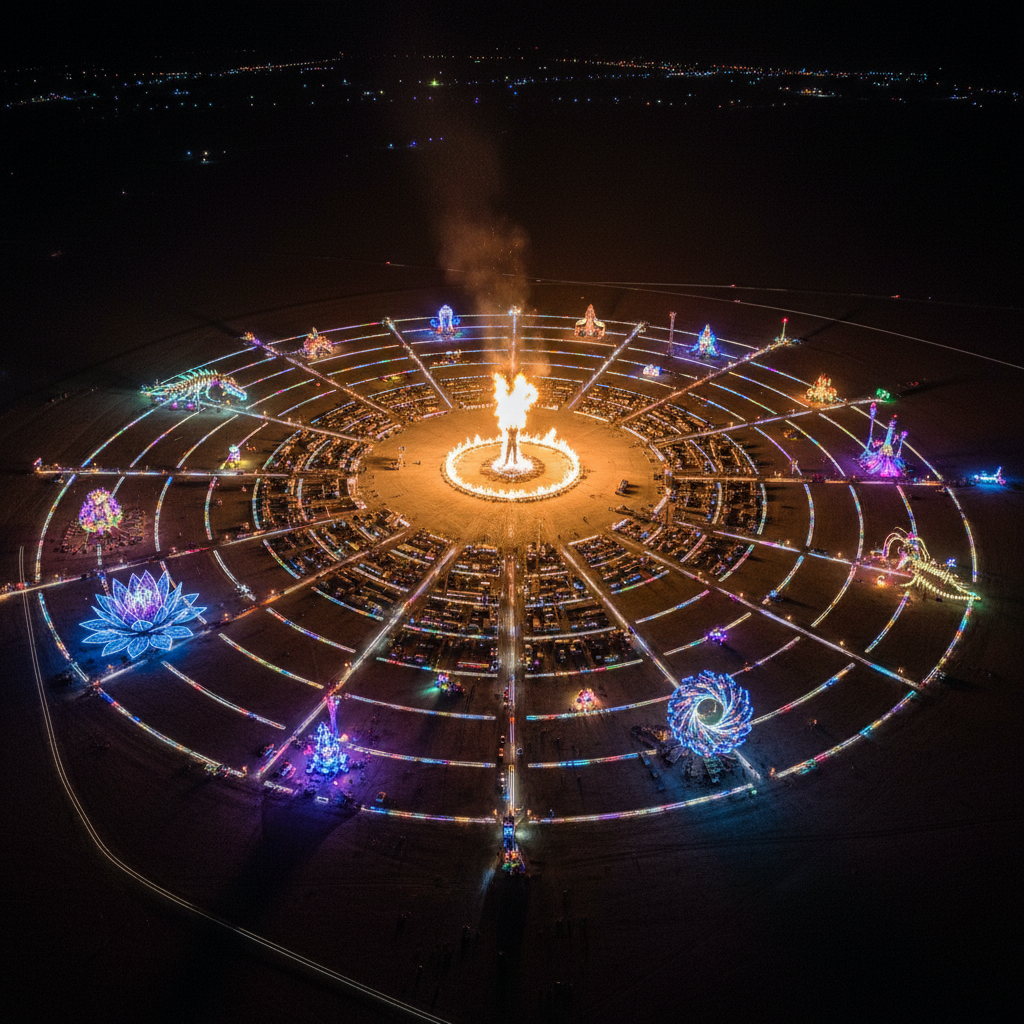
The city is laid out as a partial circle — a crescent-shaped arc of streets centred on the open playa where the large-scale art installations are placed. Streets are named alphabetically from the inner ring (Esplanade, the main boulevard) outward; addresses are given as a clock position and distance from centre. The Man — the enormous wooden effigy that gives the event its name — stands at the geographic centre on a raised platform visible from anywhere in the city. It is burned in a ceremony on the penultimate Saturday night.
The Temple — built anew each year to a different design by a commissioned artist — stands at the 12 o'clock position directly behind the Man. It is the emotional centre of the event: a place of mourning, remembrance, and meditation where participants leave photographs, letters, and mementos to people who have died. The Temple is burned on Sunday night, the final evening of the event, in silence.
**The Art**
Burning Man's art programme — funded through the BRC Honoraria grants system (burningman.org/art) and individual artist fundraising — places large-scale interactive installations across the open playa: immersive environments, kinetic sculptures, architectural follies, and participatory artworks of extraordinary ambition. The 2026 Axis Mundi theme has generated installations including light columns, labyrinthine shrines, and interactive cosmological structures. Many are illuminated at night; the playa after dark, seen from elevation, with thousands of art installations glowing and mutant vehicles cruising through them, is one of the genuinely unearthly visual experiences available on earth.
**Attending**
Tickets (burningman.org/tickets) are sold through an annual lottery beginning in late autumn — the main sale typically sells out within hours. Prices in 2026 range from $575 (low-income directed group sale) to $575 (standard) to $1,400 (FOMO sale, a premium secondary tier). Vehicle passes are required separately. Accommodation is entirely self-provided: you camp. The playa is extremely dusty (bring goggles and dust masks), extremely hot by day (temperatures regularly exceed 100°F), extremely cold at night (temperatures can drop below 45°F), and occasionally subject to severe dust storms (whiteouts) that reduce visibility to zero. It is not comfortable. That is explicitly part of the point.



Continue Reading


