Culture
Bangkok's Street Food Culture: A City That Feeds Its Soul
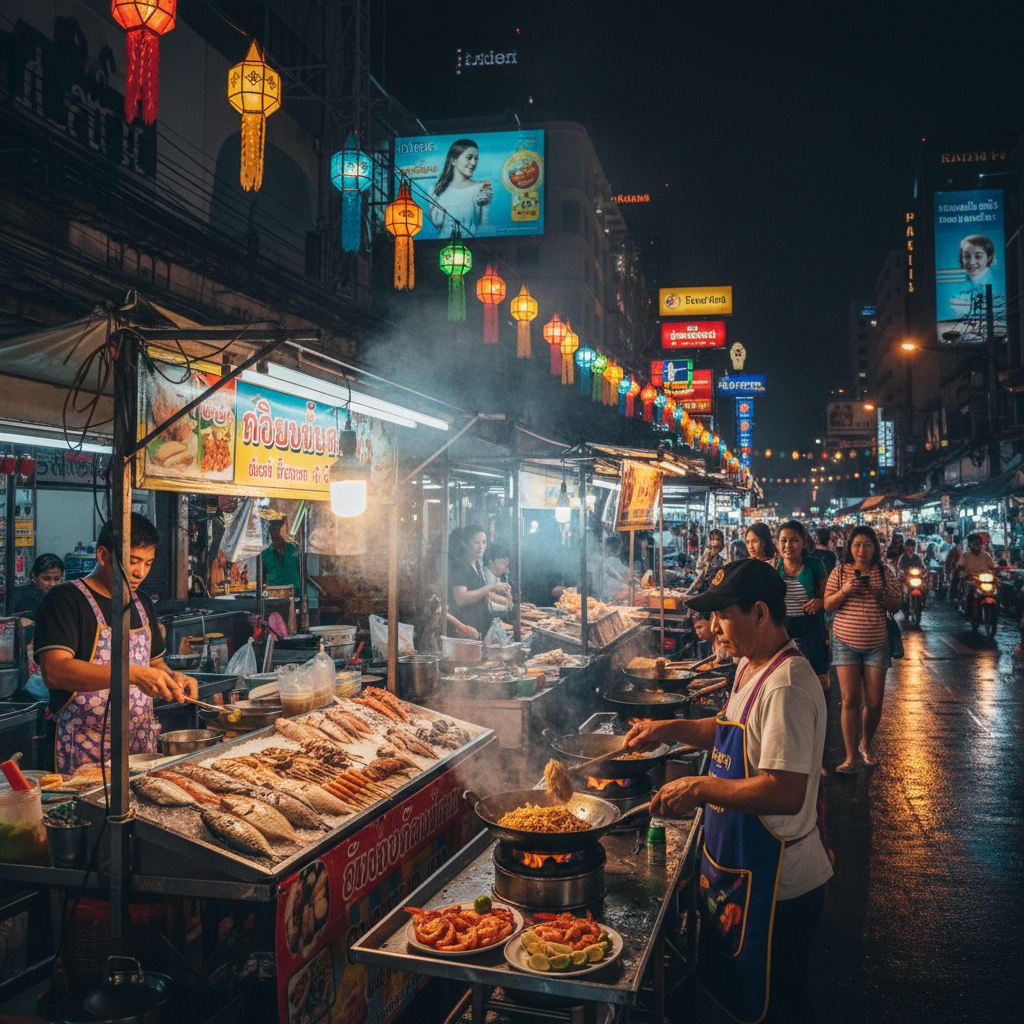
Bangkok is the world's greatest street food city — a place where the most extraordinary food is found not in restaurant dining rooms but on plastic stools at the edges of the road.
Bangkok is the undisputed capital of street food culture. In a city of ten million people, cooking and eating on the street is not a peripheral activity or a nostalgic tradition — it is the central cultural practice around which daily life organises itself. The extraordinary food that Bangkok's street vendors produce, over charcoal fires and in woks over gas burners, at all hours of the day and night, is not simplified food. It is some of the most technically accomplished, flavour-complex cooking in the world.
The Michelin Guide — which began awarding stars in Bangkok in 2017 — acknowledged this when it gave Jay Fai, a 70-something woman cooking on Samsen Road in her trademark oversized goggles, a star that she has retained ever since (michelin.com). Her crab omelette and drunken noodles, made entirely to order over the hottest wok fire in Thailand, are dishes of the very highest order. A queue of hours is standard.
**The Culture of Eating Outside**
Thai food culture is inseparable from the street. In Bangkok, eating at home has historically been less common than eating from street vendors — practical in a densely populated tropical city where outdoor cooking keeps heat out of small apartments and vendor specialisation produces better results than home cooking. A single vendor will spend decades perfecting one or two dishes; the result is a depth of technique that dedicated restaurants struggle to match.
This specialisation is key to understanding Bangkok's food landscape. The vendor on a particular corner has been making pad kra pao (basil stir-fry) for 30 years. The noodle shop around the corner has been refining their boat noodles since the owner's grandmother operated from an actual boat on the canal. The accumulated expertise of generations is in the food.
**Where to Eat**
Yaowarat Road — Bangkok's Chinatown, running through the Samphanthawong district — is the most spectacular street food environment in the city. At night, the road fills with carts and stalls selling roasted meats, seafood cooked over charcoal, mango sticky rice, fresh-cut fruit, and dozens of dishes unique to the Teochew Chinese community that has dominated this neighbourhood since the 18th century. The Tourism Authority of Thailand (tourismthailand.org) publishes walking guides to Yaowarat's food culture.
Khao San Road is for tourists. Silom Soi 20 is for Bangkokians: a daytime market of extraordinary quality, operating only in the morning and early afternoon, serving Thai-Chinese food to the office workers of the surrounding financial district. Pad see ew, basil pork rice, and fishball noodle soup of a standard unavailable in most restaurants.
Bang Rak district — the older farang (foreigner) neighbourhood along the river — contains some of the best traditional Thai food vendors in the city, less visited than Chinatown and more authentic for it. Phra Arthit Road in Banglamphu is beloved by Thai university students and serves khao tom (rice porridge) and other comfort foods around the clock.
**The Michelin Bib Gourmand list** (guide.michelin.com/th/en) for Bangkok — awarded to restaurants and street stalls of exceptional quality at modest prices — is the most authoritative guide to the city's best eating at every price point. Several of its recipients operate from sidewalk carts.
**The Night Markets**
Talat Rot Fai (the Train Night Market) in its various iterations — the Ratchada and Srinakarin locations — present a more curated, design-conscious night market experience alongside the traditional Chatuchak Weekend Market (chatuchakmarket.org), one of the world's great bazaars, where food stalls operate throughout.
Or Tor Kor Market (near Chatuchak, open daily) is considered by serious food people to be Bangkok's finest fresh market — the quality of produce, prepared foods, and packaged Thai specialities is unmatched anywhere in the city.
To eat in Bangkok properly is to abandon restaurant-thinking entirely and give yourself over to the city's street — to follow your nose down a side alley, to sit on a plastic stool at a cart that has no name and no menu, and to eat something you have never encountered before that will be, improbably, one of the best things you have ever tasted.

Continue Reading