Wellness
The Art of Doing Nothing: Dolce Far Niente as Wellness Practice
The Italian philosophy of dolce far niente — the sweetness of doing nothing — is not laziness. It is an ancient, sophisticated, and clinically validated approach to restoring the nervous system.
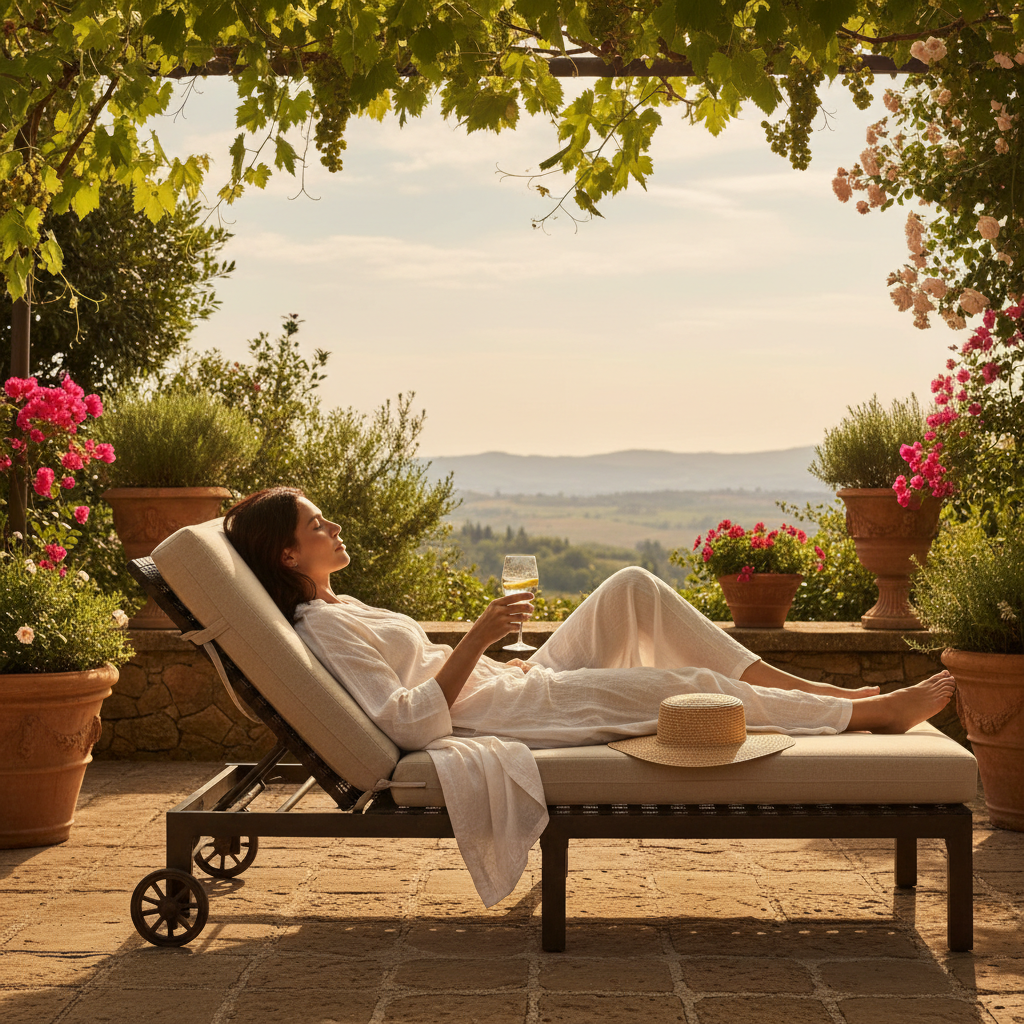
There is a particular quality of Italian afternoon — the light after lunch, the shuttered windows, the suspension of all productive ambition — that visitors to the country often experience as disorienting. This is dolce far niente: the sweetness of doing nothing. Not the absence of activity, but a deliberate, pleasurable, culturally endorsed surrender to the present moment without agenda.
The neuroscience of this state has been elucidated through research on the **Default Mode Network** (DMN) — the set of brain regions that activate precisely when external task demands are suspended. Far from being 'idle', the DMN is extraordinarily active during rest: it processes emotional memories, rehearses social scenarios, generates creative connections, and consolidates learning. Research from Stanford University (stanford.edu/rest) and the Salk Institute (salk.edu) suggests that the DMN is involved in some of the most important cognitive functions humans perform — including empathy, imagination, and the construction of personal identity.
A 2015 study in the journal Psychological Science found that mind-wandering — the hallmark mental state of the Default Mode Network — was associated with significantly enhanced creative problem-solving relative to both focused work and the same subjects simply resting with a blank mind. The brain in a state of unfocused attention is working on things it cannot access when conscious attention is directed outward.
**The cultural context**: Nordic cultures call this 'friluftsliv' (open-air living without goal); the Dutch 'niksen' (doing nothing); the Danes 'hygge' (cosy togetherness). The Danish Happiness Research Institute (happinessresearchinstitute.com) consistently finds these cultures among the world's happiest, and correlates it directly with their cultural permission to be unproductive without guilt.
**Practising dolce far niente well**: Sit — preferably outdoors, preferably in pleasant surroundings — with no device in hand and no task in mind. Permit your attention to drift to sensory experience: the light, the temperature, the sounds. Allow thoughts to arise and pass without following them. A glass of something pleasurable — a well-made mimosa, a glass of cold mineral water with a slice of lemon — is an entirely appropriate accompaniment. Duration: 20–30 minutes minimum, after lunch, daily where possible.

Continue Reading