Culture
Angkor Wat: Cambodia's Crown Jewel and the World's Largest Religious Monument
Built in the early 12th century by King Suryavarman II, Angkor Wat is the largest religious monument on earth. This UNESCO World Heritage Site, originally dedicated to Vishnu, spans 162.6 hectares and represents the pinnacle of Khmer architecture — a civilization that dominated Southeast Asia for six centuries.
Angkor Wat (whc.unesco.org/en/list/668) in Siem Reap, Cambodia, is the largest religious monument in the world. Covering 162.6 hectares (402 acres), it was built by King Suryavarman II (r. 1113–c. 1150) in the early 12th century as a Hindu temple dedicated to Vishnu, and was later transformed into a Buddhist temple. Inscribed as a UNESCO World Heritage Site in 1992, Angkor Wat is the most important archaeological site in Southeast Asia and the national symbol of Cambodia, appearing on the country's flag since 1863.
The Khmer Empire
Angkor Wat was the crowning achievement of the Khmer Empire, which dominated mainland Southeast Asia from the 9th to the 15th centuries. The empire's capital at Angkor was, at its peak around the 12th century, the largest pre-industrial city in the world, with an estimated population of 750,000 to one million people supported by an extraordinary hydraulic system of reservoirs (barays), canals, and moats.
The temple was built during the reign of Suryavarman II, who unified the Khmer Empire and expanded its territory from the South China Sea to the Bay of Bengal. Construction is believed to have taken approximately 30 years, though the exact dates remain debated by scholars. The temple was originally called Vrah Vishnuloka ('the sacred dwelling of Vishnu') and served as the king's state temple and eventual mausoleum.
Architecture and Design
Angkor Wat is oriented to the west, unusual for Khmer temples (which typically face east, toward the rising sun). This western orientation has led scholars to suggest the temple was conceived as a funerary monument, as west is associated with the god of death, Yama.
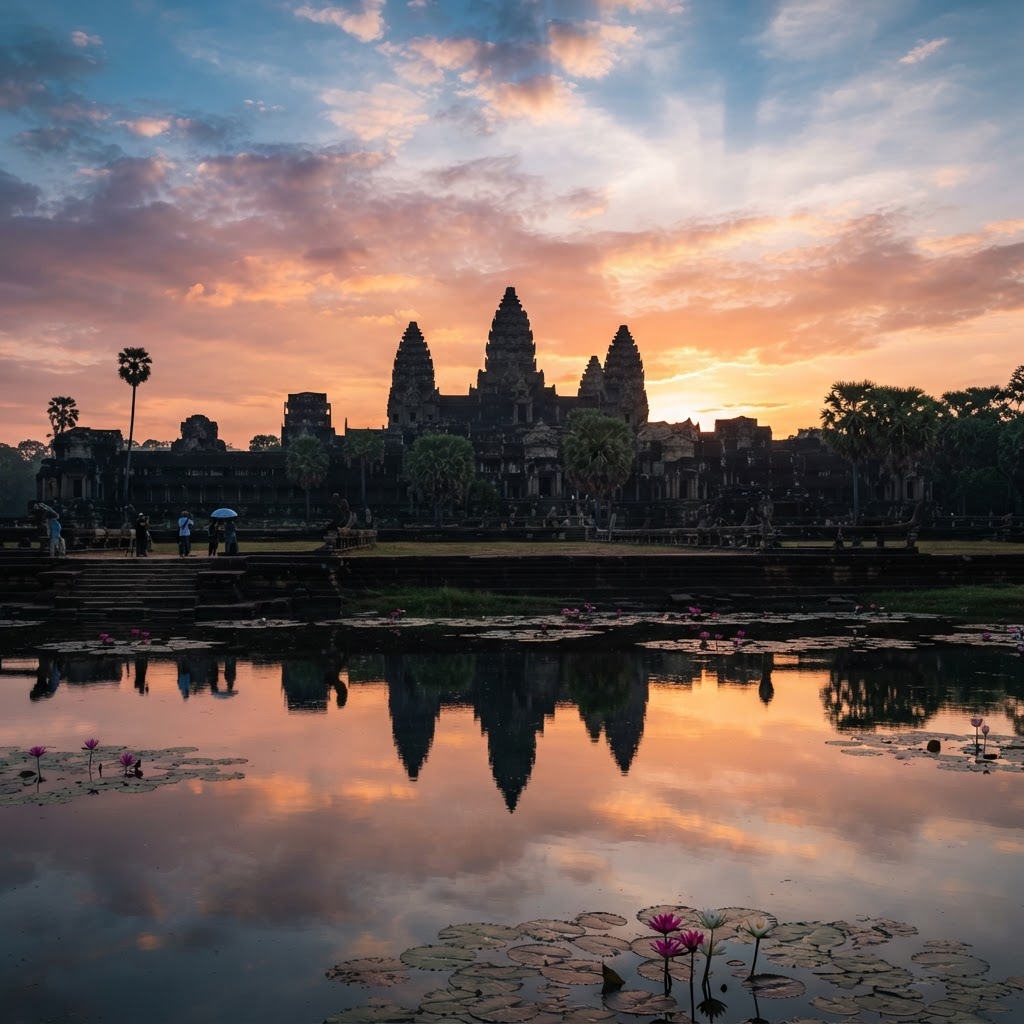
The temple is approached via a 4.5-metre-wide sandstone causeway that crosses a 190-metre-wide moat, itself part of a rectangular enclosure measuring 1.3 by 1.5 kilometres. The temple proper consists of three concentric rectangular galleries, each raised above the next, culminating in five lotus-bud-shaped towers — the central tower rising 65 metres above the ground, surrounded by four smaller towers at the corners of the second level.
The galleries are decorated with nearly 13,000 linear feet of bas-relief carvings depicting scenes from Hindu epics (the Ramayana and the Mahabharata), historical processions of Suryavarman II's court, and the mythological Churning of the Ocean of Milk. The quality and scale of these reliefs are unmatched in Khmer art.
The Gallery of 1,000 Buddhas
After Angkor Wat was converted to a Buddhist temple in the late 12th or early 13th century (likely under King Jayavarman VII, who established Mahayana Buddhism as the state religion), the temple was embellished with hundreds of Buddha images. The northern gallery became known as the Gallery of 1,000 Buddhas. The transition from Hindu to Buddhist worship was peaceful and gradual, and both religious traditions coexist at the site to this day.
Rediscovery and Preservation
Angkor Wat was never completely abandoned — Buddhist monks continued to worship at the temple throughout the centuries — but the surrounding city of Angkor was gradually reclaimed by the jungle after the Khmer Empire shifted its capital to Phnom Penh in the 15th century. The temple complex was brought to international attention by the French naturalist Henri Mouhot in 1860, whose published accounts popularized the site in the West.
The École Française d'Extrême-Orient (EFEO) began systematic restoration of Angkor in 1907, a project that was interrupted by the Cambodian Civil War and the Khmer Rouge regime (1975–79). Since 1993, the International Coordinating Committee for the Safeguarding and Development of the Historic Site of Angkor (ICC-Angkor), co-chaired by France and Japan, has coordinated restoration efforts by teams from over 20 countries.
Sunrise at Angkor Wat
The sunrise over Angkor Wat is one of the most iconic travel experiences in the world. As the sun rises behind the five towers, the temple's silhouette is reflected in the lotus ponds in front of the western entrance. The best time to visit is during the dry season (November to March), when the sky is clearest. The temple is open daily from 5:00 AM, and sunrise tickets should be purchased the day before.
Practical Information
Angkor Archaeological Park covers 400 square kilometres and contains over 1,000 temples, of which Angkor Wat is the largest and best preserved. Multi-day passes are available. The park is located 5.5 kilometres north of Siem Reap, accessible by tuk-tuk or bicycle. Reference: [UNESCO World Heritage Centre](https://whc.unesco.org/en/list/668)
Reference Links:
- UNESCO World Heritage: whc.unesco.org/en/list/668
- APSARA National Authority: apsaraauthority.gov.kh
- Tourism of Cambodia: tourismcambodia.com
- Visit Southeast Asia: visitsoutheastasia.travel
- World Heritage Travel: worldheritagesites.net/angkor

Continue Reading