Culture
The Alhambra: The Nasrid Dynasty's Greatest Masterpiece and the Crown of Moorish Spain
The Alhambra in Granada — the palace and fortress complex begun in 1238 by Muhammad I Ibn al-Ahmar — is the greatest surviving monument of Islamic Spain and one of the most beautiful buildings in the world. From the Court of the Lions to the Hall of the Ambassadors, it is the supreme achievement of Nasrid art.
The Alhambra (from the Arabic al-Qal'a al-Hamra, meaning 'the Red Castle') is a palace and fortress complex on the Sabika hill in Granada, Andalusia, in southern Spain. It is the finest surviving monument of Islamic Spain (al-Andalus) and one of the most extraordinary architectural achievements in the history of the world. The Alhambra, together with the adjoining Generalife gardens and the historic Albayzín district of Granada, was inscribed as a UNESCO World Heritage Site in 1984 (extended in 1994). Reference: [UNESCO — Alhambra, Generalife and Albayzín, Granada](https://whc.unesco.org/en/list/314)
The complex was begun in 1238 by Muhammad I Ibn al-Ahmar, the first Nasrid emir and the founder of the Emirate of Granada — the last Muslim state on the Iberian Peninsula, which survived until 1492, when Granada was conquered by the Catholic Monarchs Ferdinand and Isabella. The Nasrid dynasty ruled Granada for over 250 years, and the Alhambra was continuously expanded and embellished by successive sultans, reaching its greatest splendour in the 14th century under Yusuf I (reigned 1333–54) and his son Muhammad V (reigned 1354–59 and 1362–91).
The Palace of the Nasrids
The Nasrid Palaces (Palacios Nazaríes) are the artistic heart of the Alhambra and one of the finest expressions of Islamic architecture anywhere in the world. The palaces are organised around a series of courtyards, each a masterpiece of spatial design:
**The Court of the Myrtles (Patio de los Arrayanes)** — a rectangular court with a long reflecting pool of still, dark water, flanked by myrtle hedges. The pool mirrors the slender tower of the Comares Palace, creating one of the most celebrated architectural reflections in the world.
**The Hall of the Ambassadors (Salón de los Embajadores)** — the throne room of the Nasrid sultans, in the Comares Tower, the largest room in the Alhambra. Its ceiling is a magnificent domed star vault of cedar wood — representing the seven heavens of Islamic cosmology — with over 8,000 pieces of inlaid wood. It was in this room, in 1492, that Columbus received his commission from Ferdinand and Isabella for his voyage to the Americas.
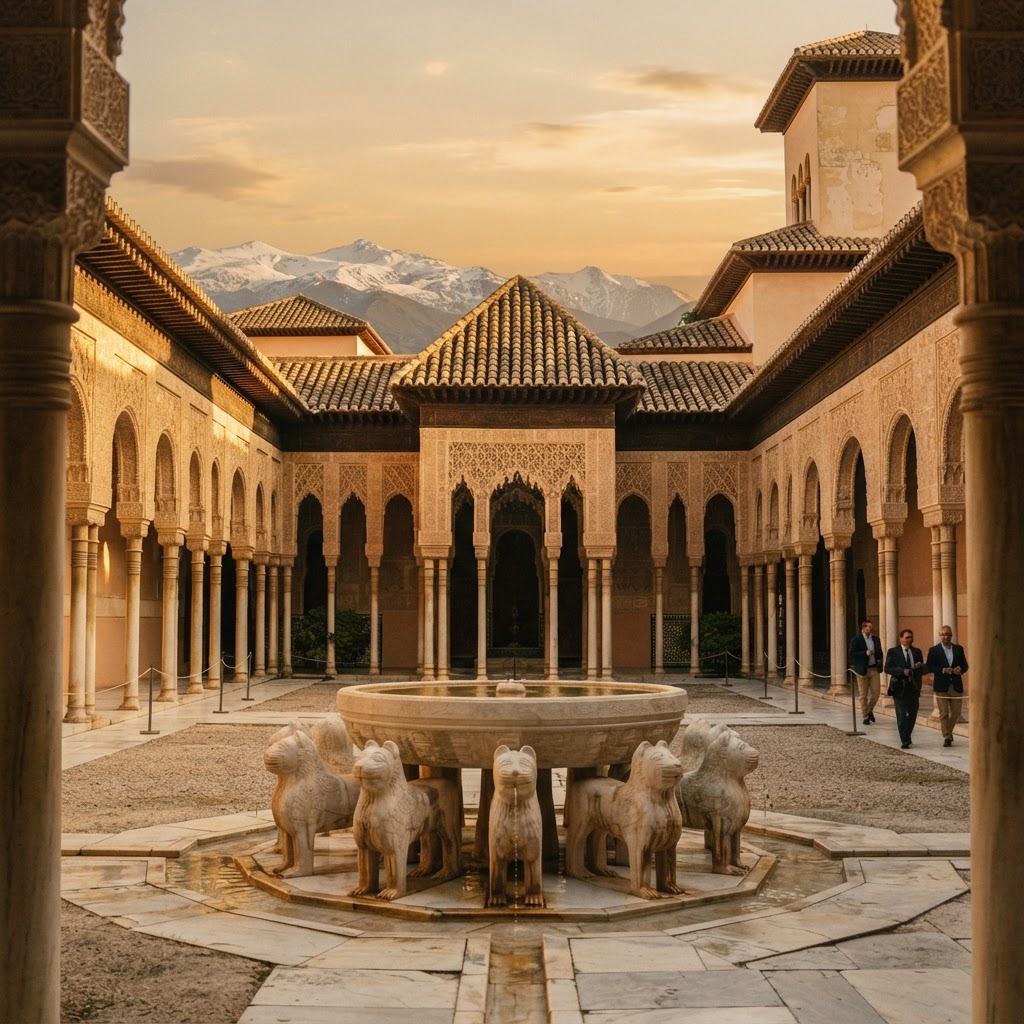
**The Court of the Lions (Patio de los Leones)** — the most famous court in the Alhambra, the private heart of the palace of Muhammad V. At its centre stands the Fountain of the Lions — a basin supported by twelve marble lions (an unusual feature in Islamic art, where the representation of living creatures is generally discouraged) — from which four channels of water flow along the axes of the courtyard, symbolising the four rivers of paradise. The court is surrounded by a gallery of 124 slender marble columns and is flanked by the Hall of the Abencerrajes and the Hall of the Two Sisters.
**The Hall of the Two Sisters (Sala de las Dos Hermanas)** — so named for the two large twin marble slabs in its floor. Its dome — a muqarnas (stalactite) ceiling of extraordinary complexity, appearing to dissolve into a honeycomb of thousands of plaster cells — is considered the finest example of Islamic ceiling design in existence.
The Generalife
The Generalife (from the Arabic Jannat al-'Arif, meaning 'Architect's Garden') was the summer palace and country estate of the Nasrid sultans, connected to the Alhambra by a covered passage. Its gardens — with their cypress alleys, water staircases, and fountains — are among the most beautiful gardens in the world. The Water Staircase (Escalera del Agua), a covered stairway with water channels running along its handrails, is one of the most photographed features of the Alhambra complex.
Practical Information
The Alhambra is the most visited monument in Spain, receiving over two million visitors annually. Tickets are strictly limited and timed entry is enforced — advance booking is absolutely essential, often weeks ahead. The official ticketing site is: [Alhambra Patronato](https://www.alhambra.org/en/). The complex is on the Sabika hill overlooking Granada, accessible on foot from the city centre or by the mini-bus C30/C32.
Reference Links:
- Alhambra Official Ticketing: alhambra.org/en/
- Patronato de la Alhambra y Generalife: patronato.alhambra.org
- UNESCO — Alhambra, Generalife and Albayzín: whc.unesco.org/en/list/314
- Granada Tourism: granadaturismo.com
- Andalusia Tourism: andalucia.org
- Spain Tourism: spain.info



Continue Reading


